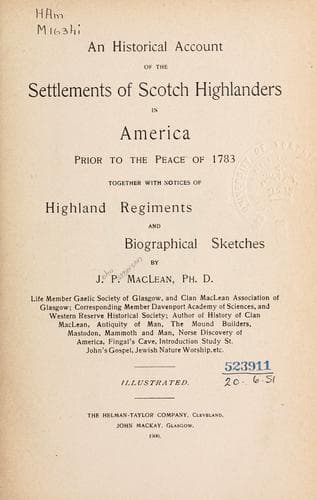
An Historical Account of the Settlements of Scotch Highlanders in AmericaMacLean, J. P. (John Patterson)
History
An Historical Account of the Settlements of Scotch Highlanders in America
MacLean, J. P. (John Patterson)
Scots -- America; Scots -- United States
"That Colonel Johnson's conduct in raising fortifications round his
house, keeping a number of Indians and armed men constantly about
him, and stopping and searching travellers upon the King's highway,
and stopping our communication with Albany, is very alarming to this
County, and is highly arbitrary, illegal, oppressive, and
unwarrantable; and confirms us in our fears, that his design is to
keep us in awe, and oblige us to submit to a state of Slavery."[106]
On the 23rd the Albany Committee warned Guy Johnson that his
interference with the rights of travellers would no longer be
tolerated.[107] So flagrant had been the conduct of the Johnsons that a
sub-committee of the city and county of Albany addressed a communication
on the subject to the Provincial Congress of New York.[108] On June 2nd
the Tryon County Committee addressed Guy Johnson, in which they affirm
"it is no more our duty than inclination to protect you in the discharge
of your province," but will not "pass over in silence the interruption
which the people of the Mohawk District met in their meeting," "and the
inhuman treatment of a man whose only crime was being faithful to his
employers."[109] The tension became still more strained between the
Johnsons and patriots during the summer.
The Dutch and German population was chiefly in sympathy with the cause
of America, as were the people generally, in that region, who did not
come under the direct influence of the Johnsons. The inhabitants deposed
Alexander White, the Sheriff of Tryon county, who had, from the first,
made himself obnoxious. The first shot, in the war west of the Hudson,
was fired by Alexander White. On some trifling pretext he arrested a
patriot by the name of John Fonda, and committed him to prison. His
friends, to the number of fifty, went to the jail and released him; and
from the prison they proceeded to the sheriff's lodgings and demanded
his surrender. He discharged a pistol at the leader, but without effect.
Immediately some forty muskets were discharged at the sheriff, with the
effect only to cause a slight wound in the breast. The doors of the
house were broken open, and just then Sir John Johnson fired a gun at
the hall, which was the signal for his retainers and Highland partisans
to rally in arms. As they could muster a force of five hundred men in a
short time, the party deemed it prudent to disperse.[110]
The royalists became more open and bolder in their course, throwing
every impediment in the way of the Safety Committee of Tryon county, and
causing embarrassments in every way their ingenuity could devise. They
called public meetings themselves, as well as to interfere with those of
their neighbors; all of which caused mutual exasperation, and the
engendering of hostile feelings between friends, who now ranged
themselves with the opposing parties.
Public-domain text, read in full here on John Shaqi.
Reviews
Reviews
No reviews yet
Be the first to share your thoughts on this work.
Elsewhere in the archive
Join the Discussion
Join the discussion
Sign in to leave a comment or review.
Sign InorCreate an account