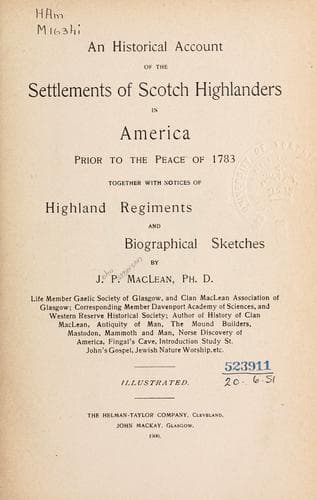
An Historical Account of the Settlements of Scotch Highlanders in AmericaMacLean, J. P. (John Patterson)
History
An Historical Account of the Settlements of Scotch Highlanders in America
MacLean, J. P. (John Patterson)
Scots -- America; Scots -- United States
On October 26th the Tryon County Committee submitted a series of
questions for Sir John Johnson to answer.[111] These questions, with Sir
John's answers, were embodied by the Committee in a letter to the
Provincial Congress of New York, under date of October 28th, as follows:
"As we found our duty and particular reasons to inquire or rather
desire Sir John Johnson's absolute opinion and intention of the three
following articles, viz:
1. Whether he would allow that his tenants may form themselves into
Companies, according to the regulations of our Continental Congress,
to the defence of our Country's cause;
2. Whether he would be willing himself also to assist personally in
the same purpose;
3. Whether he pretendeth a prerogative to our County Court-House and
Jail, and would hinder or interrupt the Committee of our County to
make use of the said publick houses for our want and service in our
common cause;
We have, therefore, from our meeting held yesterday, sent three
members of our Committee with the aforementioned questions contained
in a letter to him directed, and received of Sir John, thereupon, the
following answer:
1. That he thinks our requests very unreasonable, as he never had
denied the use of either Court-House or Jail to anybody, nor would
yet deny it for the use which these houses have been built for; but
he looks upon the Court-House and Jail at Johnstown to be his
property till he is paid seven hundred Pounds--which being out of his
pocket for the building of the same.
2. In regard of embodying his tenants into Companies, he never did
forbid them, neither should do it, as they may use their pleasure;
but we might save ourselves that trouble, he being sure they would
not.
3. Concerning himself he declared, that before he would sign any
association, or would lift his hand up against his King, he would
rather suffer that his head shall be cut off. Further, he replied,
that if we would make any unlawful use of the Jail, he would oppose
it; and also mentions that there have many unfair means been used for
signing the Association, and uniting the people; for he was informed
by credible gentlemen in New-York, that they were obliged to unite,
otherwise they could not live there. And that he was also informed,
by good authority, that likewise two-thirds of the Canajoharie and
German Flatts people have been forced to sign; and, by his opinion,
the Boston people are open rebels, and the other Colonies have joined
them.
Our Deputies replied to his expressions of forcing the people to sign
in our County; that his authority spared the truth, and it appears by
itself rediculous that one-third should have forced two-thirds to
sign. On the contrary, they would prove that it was offered to any
one, after signing, that the regretters could any time have their
names crossed, upon their requests.
Public-domain text, read in full here on John Shaqi.
Reviews
Reviews
No reviews yet
Be the first to share your thoughts on this work.
Elsewhere in the archive
Join the Discussion
Join the discussion
Sign in to leave a comment or review.
Sign InorCreate an account