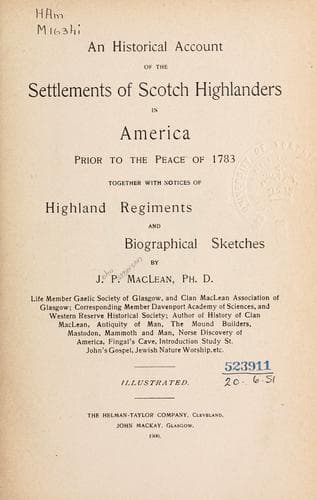
An Historical Account of the Settlements of Scotch Highlanders in AmericaMacLean, J. P. (John Patterson)
History
An Historical Account of the Settlements of Scotch Highlanders in America
MacLean, J. P. (John Patterson)
Scots -- America; Scots -- United States
John Macdonald was but a child at the date of the battle of Culloden.
When of sufficient age he was sent to Ratisbon, Germany, to be educated,
where he went through a complete course in the branches of learning as
taught in the seminary. Returning to his country he was considered to be
one of the most finished and accomplished gentlemen of his generation.
But events led him to change his prospects in life. In 1770 a violent
persecution against the Roman Catholics broke out in the island of South
Uist. Alexander Macdonald, First of Boisdale, also of the house of
Clanranald, abandoned the religion of his forbears, and like all new
converts was over zealous for his new found faith, and at once attempted
to compel all his tenants to follow his example. After many acts of
oppression, he summoned all his tenants to hear a paper read to them in
their native tongue, containing a renunciation of their religion, and a
promise, under oath, never more to hold communication with a catholic
priest. The alternative was to sign the paper or lose their lands and
homes. At once the people unanimously decided to starve rather than
submit. The next step of Boisdale was to take his gold headed cane and
drive his tenants before him, like a flock of sheep, to the protestant
church. Boisdale failed to realize that conditions had changed in the
Highlands; but, even if his methods had smacked of originality, he would
have been placed in a far better light. To attempt to imitate the
example of another may win applause, but if defeated contempt is the
lot.
The history of _Creideamh a bhata bhuidhe_, or the religion of the
yellow stick, is such an interesting episode in West Highland story as
not to be out of place in this connection. Hector MacLean, Fifth of
Coll, who held the estates from 1559 to 1593, became convinced of the
truths of the principles of the Reformation, and decided that his
tenants should think likewise. He passed over to the island of Rum, and
as his tenants came out of the Catholic church he held his cane straight
out and said in Gaelic,--"Those who pass the stick to the Kirk are very
good tenants, and those who go on the other side may go out of my
island." This stick remained in the family until 1868, when it
mysteriously disappeared. Mrs. Hamilton Dundas, daughter of Hugh,
Fifteenth of Coll, in a letter dated March 26, 1898, describing the
stick says, "There was the crest on the top and initials either H. McL.
or L. McL. in very flourishing writing engraved on a band or oval below
the top. It was a polished, yellow brown malacca stick, much taller than
an ordinary walking stick. I seem to recollect that it had two gold
rimmed eyelet holes for a cord and tassle."
Public-domain text, read in full here on John Shaqi.
Reviews
Reviews
No reviews yet
Be the first to share your thoughts on this work.
Elsewhere in the archive
Join the Discussion
Join the discussion
Sign in to leave a comment or review.
Sign InorCreate an account