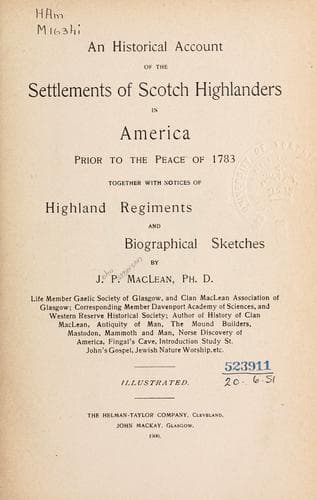
An Historical Account of the Settlements of Scotch Highlanders in AmericaMacLean, J. P. (John Patterson)
History
An Historical Account of the Settlements of Scotch Highlanders in America
MacLean, J. P. (John Patterson)
Scots -- America; Scots -- United States
John Macdonald of Glenaladale, having heard of the proceedings, went to
visit the people, and was so touched by their pitiable condition, that
he formed the resolution of expatriating himself, and going off at their
head to America. He sold out his estates to his cousin Alexander
Macdonald of Borrodale, and before the close of 1771, he purchased a
tract of forty thousand acres on St. John's Island (now Prince Edward
Island), to which he took out about two hundred of his persecuted fellow
catholics from South Uist, in the year 1772.
Whatever may have been the trials endured by these people, what ship
they sailed in, how the land was allotted, if at all given to the
public, has not come under the author's observation. Certain facts
concerning Glenaladale have been advertised. His first wife was Miss
Gordon of Baldornie, and his second, Marjory Macdonald of Ghernish, and
had issue, Donald who emigrated with him, William, drowned on the coast
of Ireland, John, Roderick and Flora. He died in 1811, and was buried on
the Island at the Scotch Fort.
Glenaladale early took up arms against the colonists, and having raised
a company from among his people, he became a Captain in the Royal
Highland Emigrants, or 84th. That he was a man of energy and pluck will
appear from the following daring enterprise. During the Revolution, an
American man-of-war came to the coast of Nova Scotia, near a port where
Glenaladale was on detachment duty, with a small portion of his men. A
part of the crew of the warship having landed for the purpose of
plundering the people, Glenaladale, with his handful of men, boarded the
vessel, cut down those who had been left in charge, hoisted sail, and
brought her as a prize triumphantly into the harbor of Halifax. He there
got a reinforcement, marched back to his former post, and took the whole
crew, composed of Americans and French. As regards his military virtues
and abilities Major John Small, of the 2nd Battalion of the Royal
Highland Emigrants, to which he was attached, writing to the English
government, said of him,--
"The activity and unabating zeal of Captain John Macdonald of
Glenaladale in bringing an excellent company into the field is his
least recommendation, being acknowledged by all who know his rank in
his Majesty's service."
Slight information may be gained of his connection with the Royal
Highland Emigrant Regiment from the "Letter-Book" of Captain Alexander
McDonald, of the same regiment. In embodying that regiment he was among
the very earliest and readiest. Just why he should have exhibited so
much feeling against the Americans whose country he had never seen and
who had never harmed him in the least, does not appear. Captain
McDonald, writing from Halifax, September 1, 1775, to Colonel Allan
MacLean, says,--
Public-domain text, read in full here on John Shaqi.
Reviews
Reviews
No reviews yet
Be the first to share your thoughts on this work.
Elsewhere in the archive
Join the Discussion
Join the discussion
Sign in to leave a comment or review.
Sign InorCreate an account