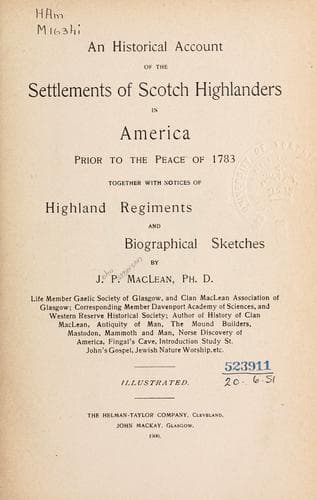
An Historical Account of the Settlements of Scotch Highlanders in AmericaMacLean, J. P. (John Patterson)
History
An Historical Account of the Settlements of Scotch Highlanders in America
MacLean, J. P. (John Patterson)
Scots -- America; Scots -- United States
The second settlement of Highlanders in British America was at Pictou,
Nova Scotia. The stream of Scottish emigration which flowed in after
years, not only over the county of Pictou, but also over the greater
portion of eastern Nova Scotia, Cape Breton, Prince Edward Island, and
even the upper provinces of Canada, was largely due to this settlement;
for these emigrants, in after years, communicated with their friends and
induced them to take up their abode in the new country. The stream once
started did not take long to deepen and widen.
A company of gentlemen, the majority of whom lived in Philadelphia,
received a grant of land in Nova Scotia. Some of the shares passed into
the hands of the celebrated Dr. John Witherspoon and John Pagan, a
merchant of Greenock, Scotland. These two men appear to have jointly
been engaged in promoting emigration to the older colonies. Pagan owned
a ship called _Hector_, which was engaged in carrying passengers across
the Atlantic. In 1770 she landed Scottish emigrants in Boston. In order
to carry out the original obligations of the grant, the proprietors
offered liberal inducements for the settlement of it. An agent, named
John Ross, was employed, with whom it was agreed that each settler
should have a free passage from Scotland, a farm, and a year's free
provisions. Ross sailed for Scotland on board the Hector, and on his
arrival proceeded to the Highlands, where he painted in glowing colors a
picture of the land and the advantages offered. The Highlanders knew
nothing of the difficulties awaiting them in a land covered over with a
dense unbroken forest, and, tempted by the prospect of owning splendid
farms, they were imposed upon, and many agreed to cast their lot on the
western side of the Atlantic. The Hector was the vessel that should
convey them, with John Spears as master, James Orr being first mate, and
John Anderson second. The vessel called first at Greenock, where three
families and five young men were taken on board. From there she sailed
for Lochbroom, in Rossshire, where she received thirty-three families
and twenty-five single men, having all told about two hundred souls.
Public-domain text, read in full here on John Shaqi.
Reviews
Reviews
No reviews yet
Be the first to share your thoughts on this work.
Elsewhere in the archive
Join the Discussion
Join the discussion
Sign in to leave a comment or review.
Sign InorCreate an account