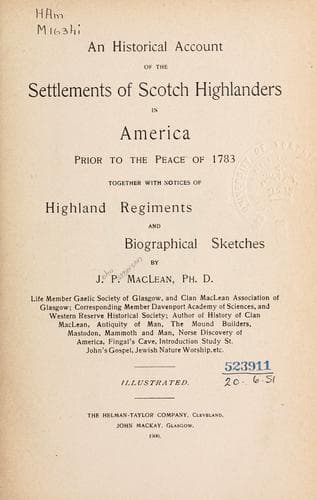
An Historical Account of the Settlements of Scotch Highlanders in AmericaMacLean, J. P. (John Patterson)
History
An Historical Account of the Settlements of Scotch Highlanders in America
MacLean, J. P. (John Patterson)
Scots -- America; Scots -- United States
On July 1, 1773, this band bade adieu to friends, home, and country and
started for a land they knew naught of. But few had ever crossed the
ocean. Just as the ship was starting a piper named John McKay came on
board who had not paid his passage; the captain ordered him ashore, but
the strains of the national instrument so affected those on board that
they interceded to have him allowed to accompany them, and offered to
share their own rations with him, in exchange for his music, during the
passage. Their request was granted, and his performance aided in no
small degree to cheer the pilgrims in their long voyage of eleven weeks,
in a miserable hulk, across the Atlantic. The band of emigrants kept up
their spirits, as best they could, by song, pipe music, dancing,
wrestling, and other amusements, during the long and painful voyage. The
Hector was an old Dutch ship, and a slow sailer. It was so rotten that
the passengers could pick the wood out of the sides with their fingers.
They met with a severe gale off the Newfoundland coast, and were driven
back so far that it required two weeks to recover the lost distance. The
accommodations on board were wretched and the provisions of inferior
quality. Small-pox and dysentery broke out among the passengers.
Eighteen, most of whom were children, died and were committed to the
deep. The former disease was brought on board by a mother and child,
both of whom lived to an advanced age. Owing to the voyage being
prolonged, the stock of provisions and water became low; the remnant of
food left consisted mostly of salt meat, which, with the scarcity of
water, added greatly to their sufferings. The oatcake, carried by them,
became mouldy, so that much of it was thrown away before they thought
such a long passage was before them; but, fortunately for them, Hugh
Macleod, more prudent than the rest, gathered into a bag these despised
scraps, and during the last few days of the voyage, all were glad to
avail themselves of this refuse food.
Public-domain text, read in full here on John Shaqi.
Reviews
Reviews
No reviews yet
Be the first to share your thoughts on this work.
Elsewhere in the archive
Join the Discussion
Join the discussion
Sign in to leave a comment or review.
Sign InorCreate an account