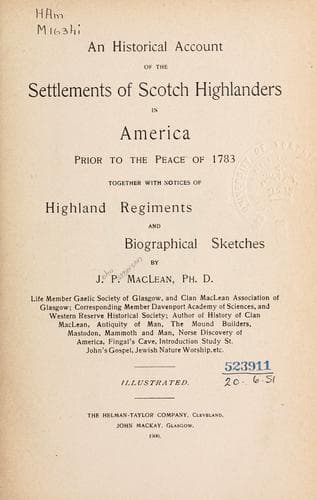
An Historical Account of the Settlements of Scotch Highlanders in AmericaMacLean, J. P. (John Patterson)
History
An Historical Account of the Settlements of Scotch Highlanders in America
MacLean, J. P. (John Patterson)
Scots -- America; Scots -- United States
As has already been intimated, amidst all the discouragements and
disappointments, the Highlanders used every means in their power to
supply the wants of their families. They rapidly learned from the
Indians and their neighbors. The former taught them the secrets of the
forests and they soon became skilled in hunting the moose, and from the
latter they became adepts in making staves, which were sent in small
vessels to the older colonies, and in exchange were supplied with
necessaries. But the population rather decreased, for a return made
January 1, 1775, showed the entire population to be but seventy-eight,
consisting of twenty-three men, fourteen women, twenty-one boys and
twenty-girls. The produce raised in 1775, was two hundred and sixty-nine
bushels of wheat, thirteen of rye, fifty-six of peas, thirty-six of
barley, one hundred of oats, and three hundred and forty pounds of flax.
The farm stock consisted of thirteen oxen, thirteen cows, fifteen young
neat cattle, twenty-five sheep and one swine. They manufactured
seventeen thousand feet of boards. While the improvement was somewhat
marked, the supply was not sufficient; and the same weary journeys must
be taken to Truro for necessaries. The moose, and the fish in the
rivers, gave them a supply of meat, and they soon learned to make sugar
from the sap of the maple tree. They learned to dig a large supply of
clams in the autumn, heap the same on the shore, and cover with sand.
Scarcely had these people become able to supply themselves, when they
were again tried by the arrival of a class poorer than themselves.
Inducements having been held out by the proprietors of Prince Edward
Island to parties in Scotland, to settle their land, John Smith and
Wellwood Waugh, living at Lockerbie, in Dumfriesshire, sold out their
property and chartered a small vessel to carry thither their families,
and all others that would accompany them. They arrived at Three Rivers,
in the year 1774, followed by others a few months later. They commenced
operations on the Island with fair prospects of success, when they were
almost overwhelmed by a plague of mice. These animals swarmed
everywhere, consuming everything eatable, even to the potatoes in the
ground; and for eighteen months the settlers experienced all the
miseries of a famine, having for several months only what lobsters or
shell-fish they could gather on the sea-shore. The winter brought them
to such a state of weakness that they were unable to convey food a
reasonable distance, even when they had means to buy it. In this
pitiable condition they heard that the Pictou people were beginning to
prosper and had provisions to spare. They sent one of their number David
Stewart to make inquiry. One of the settlers, who had come from one of
the older colonies, brought with him some negro slaves, and when the
messenger arrived had just returned from Truro to sell one of them, and
brought home with him some provisions, the proceeds of the sale of the
negro.
Public-domain text, read in full here on John Shaqi.
Reviews
Reviews
No reviews yet
Be the first to share your thoughts on this work.
Elsewhere in the archive
Join the Discussion
Join the discussion
Sign in to leave a comment or review.
Sign InorCreate an account