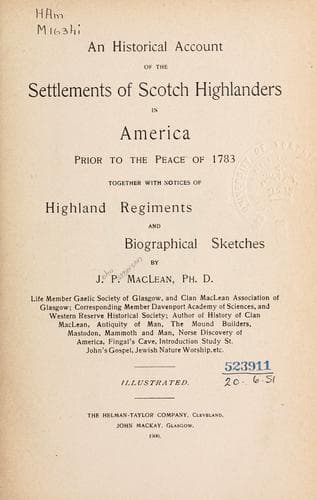
An Historical Account of the Settlements of Scotch Highlanders in AmericaMacLean, J. P. (John Patterson)
History
An Historical Account of the Settlements of Scotch Highlanders in America
MacLean, J. P. (John Patterson)
Scots -- America; Scots -- United States
The agent was cheerful in spite of his troubles; and withal was
something of a wag. On his return to the Island the people gathered
around him to hear the news. "What kind of a place is Pictou?" inquired
one. "Oh, an awful place. Why, I was staying with a man who was just
eating the last of his nigger;" and as the people were reduced
themselves they did not hesitate to believe the tale. Receiving correct
information, fifteen of the families went to Pictou, where, for a time,
they fared little better, but afterwards became prosperous and happy.
Had it not been for a French settlement a few miles distant the people
of Lockerbie would have perished during the winter. For supplies,
principally of potatoes, they exchanged the clothing they had brought
from Scotland, until they barely had enough for themselves. John Smith
who was one of the leaders removed to Truro, and Waugh left the Island
for Pictou, having only a bucket of clams to support his family on the
way.
The American Revolution effected that distant colony. The people had
received most of the supplies from the States, which was paid for in
fish, fur, and lumber. This trade was at once cut off and the people, at
first, felt it severely. Even salt could only be obtained by boiling
down sea water. The selection of Halifax as the chief depot for the
British navy promoted the business interests for that region of
country. As large sums of money were expended there, the district shared
in the prosperity. While prices for various kinds of lumber rapidly
increased, and the Pictou colony was greatly advantaged thereby, still
they found it difficult to obtain British goods, of which they were in
need until 1779, when John Patterson went to Scotland and purchased a
supply. The War had the effect to divide the colony of Pictou. Not only
the Highlanders but all others from Scotland were loyally attached to
the British government; while the earlier settlers, who were from the
States, were loyally attached to the American cause, with the exception
of Robert Patterson. Although the Americans were so situated as to be
unable to take up arms, yet they manifested their sympathy in harmless
ways, as in the refusal of tea, and the more permanent method of naming
their sons after those who were prominent in the theatre of war. At
times the feeling became quite violent, in so much so that the circular
addressed to the magistrates in the Province was sent to Pictou,
requiring these officers "to be watchful and attentive to the behaviour
of the people in your county, and that you will apprehend any person or
persons who shall be guilty of any opposition to the King's authority
and Government, and send them properly guarded to Halifax." The
inhabitants were not only required to take the oath of allegiance, but
the magistrates were compelled to send a list of all who so complied as
well as those who refused. Robert Patterson, who had been made a
magistrate in 1774, was very zealous in carrying out this order.
Public-domain text, read in full here on John Shaqi.
Reviews
Reviews
No reviews yet
Be the first to share your thoughts on this work.
Elsewhere in the archive
Join the Discussion
Join the discussion
Sign in to leave a comment or review.
Sign InorCreate an account