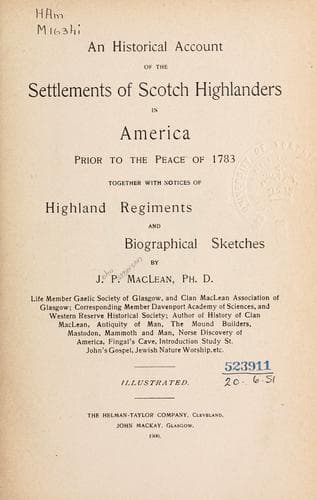
An Historical Account of the Settlements of Scotch Highlanders in AmericaMacLean, J. P. (John Patterson)
History
An Historical Account of the Settlements of Scotch Highlanders in America
MacLean, J. P. (John Patterson)
Scots -- America; Scots -- United States
When The Black Watch landed in New York they attracted much notice,
particularly on the part of the Indians, who, on the march of the
regiment to Albany, flocked from all quarters to see strangers, whom,
from the somewhat similarity of dress, they believed to be of the same
extraction with themselves, and therefore considered them to be
brothers.
During the whole of 1756 the regiment remained inactive in Albany. The
winter and spring of 1757 they were drilled and disciplined for
bush-fighting and sharpshooting, a species of warfare then necessary and
for which they were well fitted, being in general good marksmen, and
expert in the management of their arms.
[Illustration: HIGHLAND OFFICER]
In the month of June, 1757, lord Loudon, who had been appointed
commander-in-chief of the army in North America, with the 22d, 42d,
44th, 48th, 2d and 4th battalions of the 60th, together with six hundred
Rangers, making in all five thousand and three hundred men, embarked for
Halifax, where his force was increased to ten thousand and five hundred
men by the addition of five regiments lately arrived from England, which
included Fraser's and Montgomery's Highlanders. When on the eve of his
departure for an attack on Louisburg, information was received that the
Brest fleet, consisting of seventeen sail of the line, besides frigates,
had arrived in the harbor of that fortress. Letters, which had been
captured in a vessel bound from Louisburg to France, revealed that the
force was too great to be encountered. Lord Loudon abandoned the
enterprise and soon after returned to New York taking with him the
Highlanders and four other regiments.
By the addition of three new companies and the junction of seven hundred
recruits "The Black Watch" or 42nd, was now augmented to upwards of
thirteen hundred men, all Highlanders, for at that period, none others
were admitted.
During the absence of lord Loudon, Montcalm, the French commander, was
very active, and collecting all his disposable forces, including
Indians, and a large train of artillery, amounting in all to more than
eight thousand men, laid siege to Fort William Henry, under the command
of Colonel Munro. Some six miles distant was Fort Edward, garrisoned by
four thousand men under General Webb. The siege was conducted with great
vigor and within six days Colonel Munro surrendered, conditioned on not
serving again for eighteen months, and allowed to march out of the fort
with their arms and two field pieces. As soon as they were without the
gate the Indians fell upon them and committed all sorts of outrages and
barbarities,--the French being unable to restrain them.
Public-domain text, read in full here on John Shaqi.
Reviews
Reviews
No reviews yet
Be the first to share your thoughts on this work.
Elsewhere in the archive
Join the Discussion
Join the discussion
Sign in to leave a comment or review.
Sign InorCreate an account