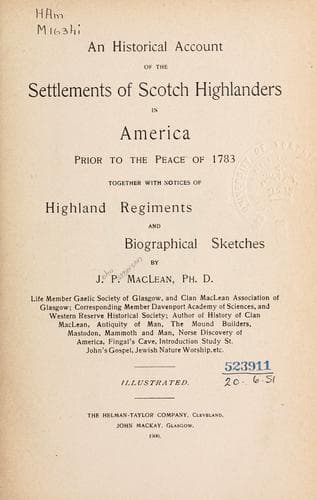
An Historical Account of the Settlements of Scotch Highlanders in AmericaMacLean, J. P. (John Patterson)
History
An Historical Account of the Settlements of Scotch Highlanders in America
MacLean, J. P. (John Patterson)
Scots -- America; Scots -- United States
Thus terminated the campaign of 1757 in America, undistinguished by any
act which might compensate for the loss of territory or the sacrifice of
lives. With an inferior force the French had been successful at every
point, and besides having obtained complete control of Lakes George and
Champlain, the destruction of Oswego gave the dominion of those lakes,
which are connected with the St. Lawrence, to the Mississippi, thus
opening a direct communication between Canada and the southwest.
Lord Loudon having been recalled, the command of the army again devolved
on General James Abercromby. Determined to wipe off the disgrace of
former campaigns, the new ministry, which had just come into power,
fitted out, in 1758, a great naval and military force consisting of
fifty-two thousand men. To the military staff were added Major-General
Amherst, and Brigadier-General's Wolfe, Townsend and Murray. Three
expeditions were proposed: the first to renew the attempt on Louisburg;
the second directed against Ticonderoga and Crown Point, and the third
against Fort du Quesne.
General Abercromby took command, in person, of the expedition against
Ticonderoga, with a force of fifteen thousand three hundred and ninety
men, of whom over six thousand were regulars, the rest being
provincials, besides a train of artillery. Among the regulars must be
reckoned the 42 Highlanders. Ticonderoga, situated on a point of land
between Lake George and Lake Champlain is surrounded on three sides by
water, and on one-half of the fourth by a morass. The remaining part of
the fort was protected by high entrenchments, supported and flanked by
three batteries, and the whole front of that which was accessible
intersected by deep traverses, and blocked up with felled trees, with
their branches turned outwards, and their points sharpened.
On July 5th the army struck their tents at daybreak, and in nine hundred
small boats and one hundred and thirty-five whale-boats, with artillery
mounted on rafts, embarked on Lake George. The fleet in stately
procession, bright with banners and cheered by martial music, moved down
the beautiful lake, beaming with hope and pride. The solemn forests were
broken by the echoes of the happy soldiery. There was no one to molest
them, and victory was their one desire. Over the broader expanse they
passed to the first narrows, witnessing the mountains rising from the
water's edge, the dark forest, and the picturesque loveliness of the
scene. Long afterwards General John Stark recounted that when they had
halted at Sabbathday Point at twilight, lord Howe, reclining in his tent
on a bearskin, and bent on winning a hero's name, questioned him closely
as to the position of Ticonderoga and the fittest modes of attack.
Public-domain text, read in full here on John Shaqi.
Reviews
Reviews
No reviews yet
Be the first to share your thoughts on this work.
Elsewhere in the archive
Join the Discussion
Join the discussion
Sign in to leave a comment or review.
Sign InorCreate an account