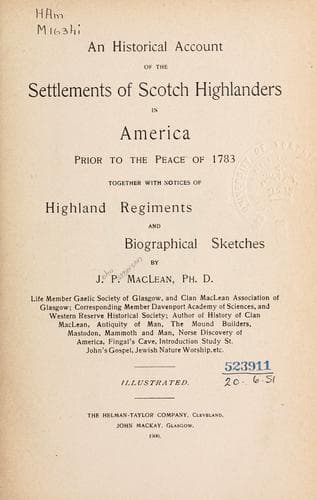
An Historical Account of the Settlements of Scotch Highlanders in AmericaMacLean, J. P. (John Patterson)
History
An Historical Account of the Settlements of Scotch Highlanders in America
MacLean, J. P. (John Patterson)
Scots -- America; Scots -- United States
The English outnumbered the French four-fold, and with their artillery,
which was near at hand, could have forced a passage. "Had I to besiege
Ticonderoga," said Montcalm, "I would ask for but six mortars and two
pieces of artillery." But Abercrombie, that evening, hurried the army to
the landing place, with such precipitancy, that but for the alertness of
Colonel Bradstreet, it would at once have rushed in a mass into the
boats. On the morning of the 9th the army embarked and Abercrombie did
not rest until he had placed the lake between himself and Montcalm, and
even then he sent the artillery and ammunition to Albany for safety.
The expedition against Louisburg, under Major-General Jeffrey Amherst,
set sail from Halifax on May 28, 1758. It was joined by the fleet under
Admiral Boscawen. The formidable armament consisted of twenty-five sail
of the line, eighteen frigates, and a number of bomb and fire ships,
with the Royals, 15th, 17th, 22nd, 28th, 35th, 40th, 45th, 47th, 48th,
58th, the 2d and 3d battalions of the 60th, 78th Highlanders, and New
England Rangers,--in all, thirteen thousand and nine men. On June 2nd
the vessels anchored in Garbarus Bay, seven miles from Louisburg. The
garrison, under the Chevalier Ducour, consisted of twenty-five hundred
regulars, six hundred militia, and four hundred Canadians and Indians.
The harbor was protected by six ships of the line and five frigates,
three of the latter being sunk at its mouth. The English ships were six
days on the coast before a landing could be attempted, on account of a
heavy surf continually rolling with such violence, that no boat could
approach the shore. The violence of the surf having somewhat abated, a
landing was effected on June 8th. The troops were disposed for landing
in three divisions. That on the left, which was destined for the real
attack, commanded by Brigadier General Wolfe, was composed of the
grenadiers and light infantry, and the 78th, or Fraser's Highlanders.
While the boats containing this division were being rowed ashore, the
other two divisions on the right and center, commanded by Brigadier
Generals Whitmore and Lawrence, made a show of landing, in order to
divide and distract the enemy. The landing place was occupied by two
thousand men entrenched behind a battery of eight pieces of cannon and
swivels. The enemy wisely reserved their fire till the boats were close
to the shore, and then directed their discharge of cannon and musketry
with considerable execution. The surf aided the fire. Many of the boats
were upset or dashed to pieces on the rocks, and numbers of the men were
killed or drowned before land was reached. Captain Baillie and
Lieutenant Cuthbert of the Highlanders, Lieutenant Nicholson of Amherts,
and thirty-eight men were killed. Notwithstanding the great
disadvantages, nothing could stop the troops when led by such a general
as Wolfe. Some of the light infantry and Highlanders were first ashore,
and drove all before them.
Public-domain text, read in full here on John Shaqi.
Reviews
Reviews
No reviews yet
Be the first to share your thoughts on this work.
Elsewhere in the archive
Join the Discussion
Join the discussion
Sign in to leave a comment or review.
Sign InorCreate an account