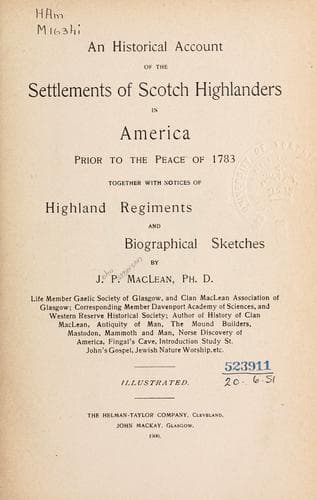
An Historical Account of the Settlements of Scotch Highlanders in AmericaMacLean, J. P. (John Patterson)
History
An Historical Account of the Settlements of Scotch Highlanders in America
MacLean, J. P. (John Patterson)
Scots -- America; Scots -- United States
The rest followed, and soon pursued the enemy
to a distance of two miles, when they were checked by the cannonading
from the town.
In this engagement the French lost seventeen pieces of cannon, two
mortars, and fourteen swivels, besides seventy-three prisoners. The
cannonading from the town enabled Wolfe to prove the range of the
enemy's guns, and to judge of the exact distance at which he might make
his camp for investing the town. The regiments then took post at the
positions assigned them. For some days operations went on slowly. The
sea was so rough that the landing of stores from the fleet was much
retarded; and it was not until the 11th that the six pounder field
pieces were landed. Six days later a squadron was fairly blown out to
sea by the tempest. By the 24th the chief engineer had thirteen
twenty-four pounders in position against the place. The first operation
was to secure a point called Lighthouse Battery, the guns from which
could play upon the ships and on the batteries on the opposite side of
the harbor. On the 12th this point was captured by Wolfe at the head of
his gallant Fraser's and flank companies, with but little loss. On the
25th, the fire from this post silenced the island battery immediately
opposite. An incessant fire, however, was kept up from the other
batteries and shipping of the enemy. On July 9th the enemy made a sortie
on General Lawrence's brigade, but were quickly repulsed. In this
affair, the earl of Dundonald was killed. There were twenty other
casualities. The French captain who led the attack, with seventeen of
his men, was also killed. On the 16th, Wolfe pushed forward some
grenadiers and Highlanders, and took possession of the hills in front of
the Lighthouse battery, where a lodgement was made under a fire from the
town and the ships. On the 21st one of the French ships was set on fire
by a bombshell and blew up, and the fire being communicated to two
others, they were burned to the water's edge. The fate of the town was
now almost decided, the enemy's fire nearly silenced and the
fortifications shattered to the ground. All that now remained in the
reduction was to get possession of the harbor, by taking or burning the
two ships of the line which remained. For this purpose the admiral, on
the night of July 25th sent six hundred seamen in boats, with orders to
take, or burn, the two ships of the line that remained in the harbor,
resolving if they succeeded to send in some of his larger vessels to
bombard the town. This enterprise was successfully executed by the
seamen under Captains Laforey and Balfour, in the face of a terrible
fire of cannon and musketry. One of the ships was set on fire and the
other towed off. On the 26th the town surrendered; the garrison and
seamen amounted to five thousand six hundred and thirty-seven, besides
one hundred and twenty pieces of cannon, eighteen mortars, seven
thousand five hundred stand of arms, eleven colors, and eleven ships of
war.
Public-domain text, read in full here on John Shaqi.
Reviews
Reviews
No reviews yet
Be the first to share your thoughts on this work.
Elsewhere in the archive
Join the Discussion
Join the discussion
Sign in to leave a comment or review.
Sign InorCreate an account