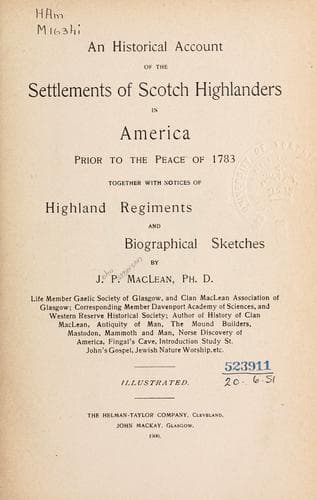
An Historical Account of the Settlements of Scotch Highlanders in AmericaMacLean, J. P. (John Patterson)
History
An Historical Account of the Settlements of Scotch Highlanders in America
MacLean, J. P. (John Patterson)
Scots -- America; Scots -- United States
The close of the French and Indian war gave to England a renewed
opportunity to tax America. The national debt had increased from
L52,092,238 in 1727 to L138,865,430 in 1763. The ministers began to urge
that the expenses of the war ought to be borne by the colonies. The
Americans contended, that they had aided England as much as she had
aided them; that the cession of Canada had amply remunerated England for
all her losses; and, further, the colonies did not dread the payment of
money, but feared that their liberties might be subverted. Early in
March 1765, the English parliament, passed the celebrated STAMP ACT,
which provided that every note, bond, deed, mortgage, lease, licence,
all legal documents of every description, every colonial pamphlet,
almanac, and newspaper, after the first day of the following November,
should be on paper furnished by the British government, the stamp cost
being from one cent to thirty dollars. When the news of the passage of
this act was brought to America the excitement was intense, and action
was resolved on by the colonies. The act was not formally repealed until
March 18, 1766. On June 29, 1767, another act was passed to tax America.
On October 1, 1768, seven hundred troops, sent from Halifax, marched
with fixed bayonets into Boston, and quartered themselves in the State
House. In February 1769 parliament declared the people of Massachusetts
rebels, and the governor was directed to arrest those deemed guilty of
treason, and send them to England for trial. In the city of New York, in
1770, the soldiers wantonly cut down a liberty pole, which had for
several years stood in the park. The most serious affray occurred on
March 5th, in Boston between a party of citizens and some soldiers, in
which three citizens were shot down and several wounded. This massacre
inflamed the city with a blaze of excitement. On that day lord North
succeeded in having all the duties repealed except that on tea; and that
tax, in 1773, was attempted to be enforced by a stratagem. On the
evening of December 16th, the tea, in the three tea-ships, then in
Boston harbor, was thrown overboard, by fifty men disguised as Indians.
Parliament, instead of using legal means, hastened to find revenge. On
March 31, 1774, it was enacted that Boston port should be closed.
The final act which brought on the Revolution was the firing upon the
seventy minute men, who were standing still at Lexington, by the English
soldiers under Major Pitcairn, on April 19, 1775, sixteen of the
patriots fell dead or wounded. The first gun of the Revolution fired the
entire country, and in a few days Boston was besieged by the militia
twenty thousand strong. Events passed rapidly, wrongs upon wrongs were
perpetrated, until, finally, on July 4, 1776, the Declaration of
Independence was published to the world. By this act all hope of
reconciliation was at an end. Whatever concessions might be made by
England, her own acts had caused an impassable gulf.
Public-domain text, read in full here on John Shaqi.
Reviews
Reviews
No reviews yet
Be the first to share your thoughts on this work.
Elsewhere in the archive
Join the Discussion
Join the discussion
Sign in to leave a comment or review.
Sign InorCreate an account