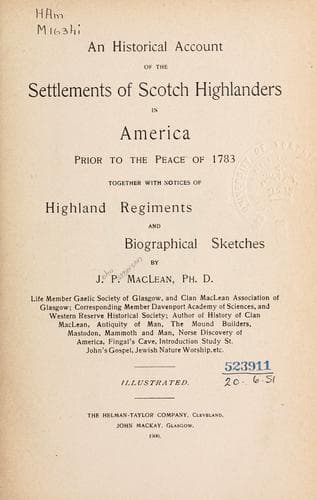
An Historical Account of the Settlements of Scotch Highlanders in AmericaMacLean, J. P. (John Patterson)
History
An Historical Account of the Settlements of Scotch Highlanders in America
MacLean, J. P. (John Patterson)
Scots -- America; Scots -- United States
America had done all within her power to avert the impending storm. Her
petitions had been spurned from the foot of the English throne. Even the
illustrious Dr. Franklin, venerable in years, was forced to listen to a
vile diatribe against him delivered by the coarse and brutal Wedderburn,
while members of the Privy Council who were present, with the single
exception of lord North, "lost all dignity and all self-respect. They
laughed aloud at each sarcastic sally of Wedderburn. 'The indecency of
their behaviour,' in the words of Shelburne, 'exceeded, as is agreed on
all hands, that of any committee of elections;' and Fox, in a speech
which he made as late as 1803, reminded the House how on that memorable
occasion 'all men tossed up their hats and clapped their hands in
boundless delight at Mr. Wedderburn's speech.'"[143]
George III., his ministers and his parliament hurled the country
headlong into war, and that against the judgment of her wisest men, and
her best interests. To say the least the war was not popular in England.
The wisest statesmen in both Houses of Parliament plead for
reconciliation, but their efforts fell on callous ears. The ruling class
was seized with the one idea of humbling America. They preferred to
listen to such men as Major James Grant,--the same who allowed his men,
(as has been already narrated) to be scandalously slaughtered before
Fort du Quesne, and had made himself offensive in South Carolina under
Colonel Montgomery. This braggart asserted, in the House of Commons,
"amidst the loudest cheering, that he knew the Americans very well, and
was certain they would not fight; 'that they were not soldiers and
never could be made so, being naturally pusillanimous and incapable of
discipline; that a very slight force would be more than sufficient for
their complete reduction'; and he fortified his statement by repeating
their peculiar expressions, and ridiculing their religious enthusiasm,
manners and ways of living, greatly to the entertainment of the
house."[144]
The great Pitt, then earl of Chatham, in his famous speech in January
1775, declared:
Public-domain text, read in full here on John Shaqi.
Reviews
Reviews
No reviews yet
Be the first to share your thoughts on this work.
Elsewhere in the archive
Join the Discussion
Join the discussion
Sign in to leave a comment or review.
Sign InorCreate an account