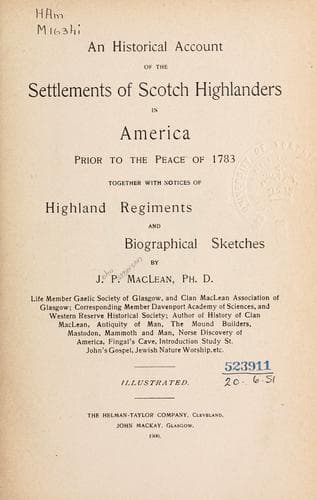
An Historical Account of the Settlements of Scotch Highlanders in AmericaMacLean, J. P. (John Patterson)
History
An Historical Account of the Settlements of Scotch Highlanders in America
MacLean, J. P. (John Patterson)
Scots -- America; Scots -- United States
"The spirit which resists your taxation in America is the same that
formerly opposed loans, benevolences, and ship-money in England. * *
* This glorious spirit of Whiggism animates three millions in America
who prefer poverty with liberty to gilded chains and sordid
affluence, and who will die in defence of their rights as freemen. *
* * For myself, I must declare that in all my reading and
observation--and history has been my favorite study; I have read
Thucydides, and have studied and admired the master states of the
world--that for solidity of reasoning, force of sagacity, and wisdom
of conclusion under such a complication of difficult circumstances,
no nation or body of men can stand in preference to the General
Congress at Philadelphia. * * * All attempts to impose servitude upon
such men, to establish despotism over such a mighty continental
nation, must be vain, must be fatal. We shall be forced ultimately to
retreat. Let us retreat while we can, not when we must."
In accordance with these sentiments Chatham withdrew his eldest son from
the army rather than suffer him to be engaged in the war. Lord
Effingham, finding his regiment was to serve against the Americans,
threw up his commission and renounced the profession for which he had
been trained and loved, as the only means of escaping the obligation of
fighting against the cause of freedom. Admiral Keppel, one of the most
gallant officers in the British navy, expressed his readiness to serve
against the ancient enemies of England, but asked to be released from
employment against the Americans. It is said that Amherst refused to
command the army against the Americans. In 1776 it was openly debated in
parliament whether British officers ought to serve their sovereign
against the Americans, and no less a person then General Conway leaned
decidedly to the negative, and compared the case to that of French
officers who were employed in the Massacre of St. Bartholomew. Just
after the battle of Bunker Hill, the duke of Richmond declared in
parliament that he "did not think that the Americans were in rebellion,
but that they were resisting acts of the most unexampled cruelty and
oppression." The Corporation of London, in 1775, drew up an address
strongly approving of the resistance of the Americans, and similar
addresses were expressed by other towns. A great meeting in London, and
also the guild of merchants in Dublin, returned thanks to lord Effingham
for his recent conduct. When Montgomery fell at the head of the American
troops before Quebec, he was eulogized in the British parliament.
Public-domain text, read in full here on John Shaqi.
Reviews
Reviews
No reviews yet
Be the first to share your thoughts on this work.
Elsewhere in the archive
Join the Discussion
Join the discussion
Sign in to leave a comment or review.
Sign InorCreate an account