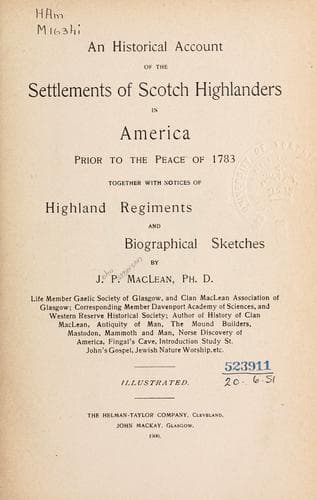
An Historical Account of the Settlements of Scotch Highlanders in AmericaMacLean, J. P. (John Patterson)
History
An Historical Account of the Settlements of Scotch Highlanders in America
MacLean, J. P. (John Patterson)
Scots -- America; Scots -- United States
It is a fact, worthy of special notice, that in both England and Ireland
there was a complete absence of alacrity and enthusiasm in enlisting for
the army and navy. This was the chief reason why George III. turned to
the petty German princes who trafficked in human chattels. There people
were seized in their homes, or while working the field, and sold to
England at so much per head. On account of the great difficulty in
England in obtaining voluntary recruits for the American war, the
press-gang was resorted to, and in 1776, was especially fierce. In less
than a month eight hundred men were seized in London alone, and several
lives were lost in the scuffles that took place. The press-gang would
hang about the prison-gates, and seize criminals whose sentences had
expired and force them into the army.
"It soon occurred to the government that able-bodied criminals might be
more usefully employed in the coercion of the revolted colonists, and
there is reason to believe that large numbers of criminals of all but
the worst category, passed at this time into the English army and navy.
In estimating the light in which British soldiers were regarded in
America, and in estimating the violence and misconduct of which British
soldiers were sometimes guilty, this fact must not be forgotten." In
Ireland criminals were released from their prisons on condition of
enlisting in the army or navy.[145]
The regular press-gang was not confined to England, and it formed one of
the grievances of the American colonists. One of the most terrible riots
ever known in New England, was caused, in 1747, by this nefarious
practice, under the sanction of Admiral Knowles. An English vessel was
burnt, and English officers were seized and imprisoned by the crowd; the
governor was obliged to flee to the castle; the sub-sheriffs were
impounded in the stocks; the militia refused to act against the people;
and the admiral was compelled to release his captives. Resistance, in
America, was shown in many subsequent attempts to impress the people.
The king and his ministers felt it was necessary to sustain the acts of
parliament in the American war by having addresses sent to the king
upholding him in the course he was pursuing. Hence emissaries were sent
throughout the kingdom who cajoled the ignorant into signing such
papers. The general sentiment of the people cannot be estimated by the
number of addresses for they were obtained by the influence of the
ministers of state. Every magistrate depending upon the favor of the
crown could and would exert his influence as directed. Hence there were
numerous addresses sent to the king approving the course he was bent
upon. When it is considered that the government had the advantage of
more than fifty thousand places and pensions at its disposal, the
immense lever for securing addresses is readily seen. From no section of
the country, however, were these addresses so numerous as from Scotland.
Public-domain text, read in full here on John Shaqi.
Reviews
Reviews
No reviews yet
Be the first to share your thoughts on this work.
Elsewhere in the archive
Join the Discussion
Join the discussion
Sign in to leave a comment or review.
Sign InorCreate an account