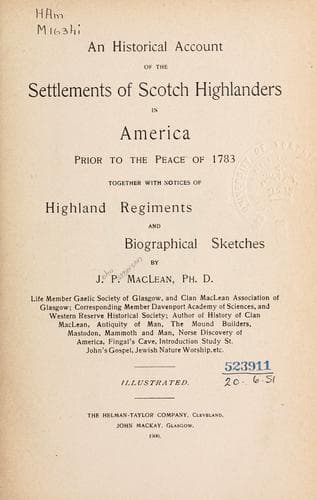
An Historical Account of the Settlements of Scotch Highlanders in AmericaMacLean, J. P. (John Patterson)
History
An Historical Account of the Settlements of Scotch Highlanders in America
MacLean, J. P. (John Patterson)
Scots -- America; Scots -- United States
"Most Gracious Sovereign" declared themselves also to be the "most
dutiful and loyal subjects;" they approved the "lenient measures" which
had hitherto been taken in America by parliament, "and that they will
support with their lives and fortunes, the vigorous exertions which they
forsee may soon be necessary to subdue a rebellion premeditated,
unprovoked, and that is every day becoming more general, untainted by
the vices that too often accompany affluence, our people have been
inured to industry, sobriety, and, when engaged in your Majesty's
service, have been distinguished for an exact obedience to discipline,
and a faithful discharge of duty; and we hope, if called forth to action
in one combined corps, it will be their highest ambition to merit a
favorable report to your Majesty from their superior officers. At the
same time, it is our most ardent prayer to Almighty God, that the eyes
of our deluded fellow-subjects in America may soon be opened, to see
whether it is safe to trust in a Congress unconstitutionally assembled,
in a band of officers unconstitutionally appointed, or in a British King
and Parliament whose combined powers have indeed often restrained the
licentiousness, but never invaded the rational liberties of mankind."
A survey of the addresses indicates that they were composed by one
person, or else modelled from the same formula. All had the same source
of inspiration. This, however, does not militate against the moral
effect of those uttering them. So far as Scotland is concerned, it must
be regarded as a fair representation of the sentiment of the people.
While only an insignificant part of the Highlands gave their humble
petitions, yet the subsequent acts must be the criterion from which a
judgment must be formed.
It is possible that some of the loyal addresses were accelerated by the
prohibition placed on Scotch emigration to America. Early in September,
1775, Henry Dundas, lord-advocate for Scotland, urged the board of
customs to issue orders to all inferior custom houses enjoining them to
grant no clearances for America of any ship which had more than the
common complement of hands on board. On September 23, 1775, Archibald
Cockburn, sheriff deputy of Edinburgh, issued the following order:
Public-domain text, read in full here on John Shaqi.
Reviews
Reviews
No reviews yet
Be the first to share your thoughts on this work.
Elsewhere in the archive
Join the Discussion
Join the discussion
Sign in to leave a comment or review.
Sign InorCreate an account