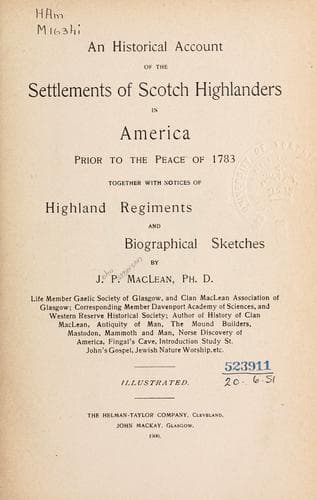
An Historical Account of the Settlements of Scotch Highlanders in AmericaMacLean, J. P. (John Patterson)
History
An Historical Account of the Settlements of Scotch Highlanders in America
MacLean, J. P. (John Patterson)
Scots -- America; Scots -- United States
"Whereas a letter[148] was received by me some time ago, from His
Majesty's Advocate for Scotland, intimating that, on account of the
present rebellion in America, it was proper a stop should be put for
the present to emigrations to that Country, and that the necessary
directions were left at the different sea-ports in Scotland to that
purpose; I think it my duty, in obedience to his Lordship's
requisition contained in that letter, to take this publick method of
notifying to such of the inhabitants within my jurisdiction, if any
such there be, who have formed resolutions to themselves of leaving
this Country, and going in quest of settlements in America, that they
aught not to put themselves to the unnecessary trouble and expense of
preparing for a removal of their habitations, which they will not, so
far as it lies in my power to prevent, be permitted to effectuate."
The British government had every assurance of the undivided support of
all Scotland in its attempt to subjugate America. It also put a strong
dependence in enlisting in the army such Highlanders as had emigrated,
and especially those who had belonged to the 42nd, Fraser's, and
Montgomery's regiments, but remained in the country after the peace of
1763. This alone would make a very unfavorable impression on the minds
of Americans. But when to this is added the efforts of British officers
to organize the emigrants from the Highlands into a special regiment, as
early as November, 1775, the rising of the Highlanders both in North
Carolina and on the Mohawk, the enlisting of emigrants on board vessels
before landing and sailing by Boston to join their regiments at Halifax,
and on the passage listening to the booming of the cannon at Bunker
Hill; and the further fact that both the 42nd and Fraser's Highlanders
were ordered to embark at Greenock for America, five days before the
battle of Lexington, it is not a matter of surprise that a strong
resentment should be aroused in the breasts of many of the most devoted
to the cause of the Revolution.
The feeling engendered by the acts of Scotland towards those engaged in
the struggle for human liberty crops out in the original draft of the
Declaration of Independence as laid before Congress July 1, 1776. In the
memorable paper appeared the following sentence: "At this very time,
too, they are permitting their chief magistrate to send over, not only
soldiers of our common blood, but Scotch and foreign mercenaries to
invade and destroy us." The word "Scotch" was struck out, on motion of
Dr. John Witherspoon, himself a native of Scotland; and subsequently the
whole sentence was deleted.
Public-domain text, read in full here on John Shaqi.
Reviews
Reviews
No reviews yet
Be the first to share your thoughts on this work.
Elsewhere in the archive
Join the Discussion
Join the discussion
Sign in to leave a comment or review.
Sign InorCreate an account