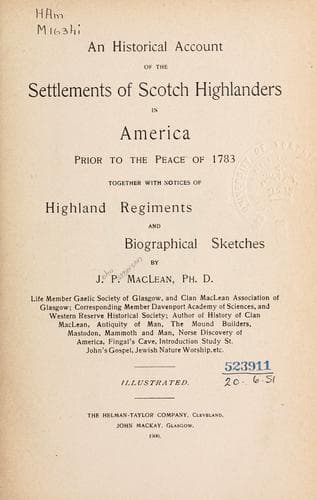
An Historical Account of the Settlements of Scotch Highlanders in AmericaMacLean, J. P. (John Patterson)
History
An Historical Account of the Settlements of Scotch Highlanders in America
MacLean, J. P. (John Patterson)
Scots -- America; Scots -- United States
The men belonging to the first battalion were assembled at Quebec. On
the approach of the American army by Lake Champlain, Colonel Maclean was
ordered to St. Johns with a party of militia, but got only as far as St.
Denis, where he was deserted by his men. When Quebec was threatened by
the American army under Colonel Arnold, Colonel Maclean with his
regiment consisting of three hundred and fifty men, was at Sorel, and
being forced to decamp from that place, by great celerity of movement,
evaded the army of Colonel Arnold and passed into Quebec with one
hundred of his regiment. He arrived just in time, for the citizens were
about to surrender the city to the Americans. On Colonel Maclean's
arrival, November 13, 1775, the garrison consisted only of fifty men of
the Fusiliers and seven hundred militia and seamen. There had also just
landed one hundred recruits of Colonel Maclean's corps from
Newfoundland, which had been raised by Malcolm Fraser and Captain
Campbell. Also, at the same time, there arrived the frigate Lizard, with
L20,000 cash, all of which put new spirits into the garrison. The
arrival of the veteran Maclean greatly diminished the chances of Colonel
Arnold. Colonel Maclean now bent his energies towards saving the town;
strengthened every point; enthused the lukewarm, and by emulation kept
up a good spirit among them all. When General Carleton, leaving his army
behind him, arrived in Quebec he found that Colonel Maclean had not only
withstood the assaults of the Americans but had brought order and system
out of chaos. In the final assault on the last day of the year, when the
brave General Montgomery fell, the Highlanders were in the midst of the
fray.
Many of the Americans were captured at this storming of Quebec. One of
them narrates that "January 4th, on the next day, we were visited by
Colonel Maclean, an old man, attended by other officers, for a peculiar
purpose, that is, to ascertain who among us were born in Europe. We had
many Irishmen and some Englishmen. The question was put to each; those
who admitted a British birth, were told they must serve his majesty in
Colonel Maclean's regiment, a new corps, called the emigrants. Our poor
fellows, under the fearful penalty of being carried to Britain, there to
be tried for treason, were compelled by necessity, and many of them did
enlist."[153]
Such men could hardly prove to be reliable, and it can be no
astonishment to read what Major Henry Caldwell, one of the defenders of
Quebec says of it:
"Of the prisoners we took, about 100 of them were Europeans, chiefly
from Ireland; the greatest part of them engaged voluntarily in Col.
McLean's corps, but about a dozen of them deserting in the course of
a month, the rest were again confined, and not released till the
arrival of the Isis, when they were again taken into the corps."[154]
Public-domain text, read in full here on John Shaqi.
An Historical Account of the Settlements of Scotch Highlanders in America — John Shaqi
Reviews
Reviews
No reviews yet
Be the first to share your thoughts on this work.
Elsewhere in the archive
Join the Discussion
Join the discussion
Sign in to leave a comment or review.
Sign InorCreate an account