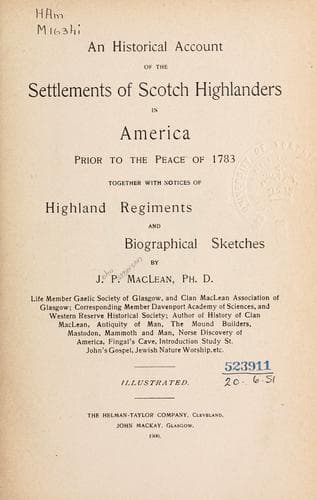
An Historical Account of the Settlements of Scotch Highlanders in AmericaMacLean, J. P. (John Patterson)
History
An Historical Account of the Settlements of Scotch Highlanders in America
MacLean, J. P. (John Patterson)
Scots -- America; Scots -- United States
Colonel Arnold despairing of capturing the town by assault, established
himself on the Heights of Abraham, with the intention of cutting off
supplies and blockading the town. In this situation he reduced the
garrison to great straits, all communication with the country being cut
off. He erected batteries and made several attempts to get possession of
the lower town, but was foiled at every point by the vigilance of
Colonel Maclean. On the approach of spring, Colonel Arnold, despairing
of success, raised the siege.
The battalion remained in the province of Canada during the war, and was
principally employed in small, but harrassing enterprises. In one of
these, Captain Daniel Robertson, Lieutenant Hector Maclean, and Ensign
Archibald Grant, with the grenadier company, marched twenty days through
the woods with no other direction than the compass, and an Indian guide.
The object being to surprise a small post in the interior, which was
successful and attained without loss. By long practice in the woods the
men had become very intelligent and expert in this kind of warfare.
The reason why this regiment was not with the army of General Burgoyne,
and thus escaped the humiliation of the surrender at Saratoga, has been
stated by that officer in the following language: that he proposed to
leave in Canada "Maclean's Corps, because I very much apprehend
desertions from such parts of it as are composed of Americans, should
they come near the enemy. In Canada, whatsoever may be their
disposition, it is not so easy to effect it."[155]
Notwithstanding the conduct of Colonel Allan Maclean at the siege of
Quebec and his great zeal in behalf of Britain his corps was not yet
recognized, though he had at the outset been promised establishment and
rank for it. He therefore returned to England where he arrived on
September 1, 1776, to seek justice for himself and men. They were not
received until the close of 1778, when the regiment was numbered the
84th, at which time Sir Henry Clinton was appointed its Colonel, and the
battalions ordered to be augmented to one thousand men each. The uniform
was the full Highland garb, with purses made of raccoons' instead of
badger's skins. The officers wore the broad sword and dirk, and the men
a half basket sword.
Public-domain text, read in full here on John Shaqi.
Reviews
Reviews
No reviews yet
Be the first to share your thoughts on this work.
Elsewhere in the archive
Join the Discussion
Join the discussion
Sign in to leave a comment or review.
Sign InorCreate an account