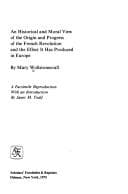
An historical and moral view of the origin and progress of the French Revolution; and the effect it has produced in EuropeWollstonecraft, Mary
Philosophy
An historical and moral view of the origin and progress of the French Revolution; and the effect it has produced in Europe
Wollstonecraft, Mary
France -- History -- Revolution, 1789-1799 -- Causes
It appears to be the grand province of government, though scarcely
acknowledged, so to hold the balance, that the abilities or riches of
individuals may not interfere with the equilibrium of the whole. For, as
it is vain to expect, that men should master their passions during the
heat of action, legislators should have this perfection of laws ever in
view, when, calmly grasping the interest of humanity, reason assures
them, that their own is best secured by the security of the commonweal.
The first social systems were certainly founded by passion; individuals
wishing to fence round their own wealth or power, and make slaves of
their brothers to prevent encroachment. Their descendants have ever been
at work to solder the chains they forged, and render the usurpations of
strength secure, by the fraud of partial laws: laws that can be
abrogated only by the exertions of reason, emancipating mankind, by
making government a science, instead of a craft, and civilizing the
grand mass, by exercising their understandings about the most important
objects of inquiry.
After the revolution in 1688, however, political questions were no
longer discussed in England on a broad scale; because that degree of
liberty was enjoyed, which enabled thinking men to pursue without
interruption their own business; or, if some men complained, they
attached themselves to a party, and descanted on the unavoidable misery
produced by contending passions.
But in France the bitterness of oppression was mingled in the daily cup,
and the serious folly of superstition, pampered by the sweat of labour,
stared every man of sense in the face. Against superstition then did the
writers contending for civil liberty principally direct their force,
though the tyranny of the court increased with it’s viciousness.
Voltaire leading the way, and ridiculing with that happy mixture of
satire and gaiety, calculated to delight the french, the inconsistent
puerilities of a puppet-show religion, had the art to attach the bells
to the fool’s cap, which tinkled on every side, rousing the attention
and piquing the vanity of his readers. Rousseau also ranged himself on
the same side; and, praising his fanciful state of nature, with that
interesting eloquence, which embellishes reasoning with the charms of
sentiment, forcibly depicted the evils of a priest-ridden society, and
the sources of oppressive inequality, inducing the men who were charmed
with his language to consider his opinions.
The talents of these two writers were particularly formed to effect a
change in the sentiments of the french, who commonly read to collect a
fund for conversation; and their biting retorts, and flowing periods,
were retained in each head, and continually slipped off the tongue in
numerous sprightly circles.
Public-domain text, read in full here on John Shaqi.
Reviews
Reviews
No reviews yet
Be the first to share your thoughts on this work.
Join the Discussion
Join the discussion
Sign in to leave a comment or review.
Sign InorCreate an account