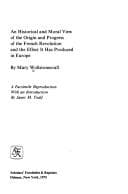
An historical and moral view of the origin and progress of the French Revolution; and the effect it has produced in EuropeWollstonecraft, Mary
Philosophy
An historical and moral view of the origin and progress of the French Revolution; and the effect it has produced in Europe
Wollstonecraft, Mary
France -- History -- Revolution, 1789-1799 -- Causes
reason, enforced by affection?—And who will coolly maintain, that it is
just to deprive a woman, not to insist on her being treated as an
outcast of society, of all the rights of a citizen, because her
revolting heart turns from the man, whom, a husband only in name, and by
the tyrannical power he has over her person and property, she can
neither love nor respect, to find comfort in a more congenial or humane
bosom? These are a few of the leading prejudices, in the present
constitution of society, that blast the blossoms of hope, and render
life wretched and useless—And, when such were tolerated, nay, reckoned
sacred, who can find more than doubtful traces of the perfection of man
in a system of association pervaded with such abuses? Voluptuousness
alone softened the character down to tenderness of heart; and as taste
was cultivated, peace was sought, rather because it was convenient, than
because it was just. But, when war could not be avoided, men were hired
by the rich to secure to them the quiet enjoyment of their luxuries; so
that war, become a trade, did not render ferocious all those who
directly, or indirectly waged it.
When, therefore, the improvements of civil life consisted almost
entirely in polishing the manners, and exercising the transient
sympathies of the heart, it is clear, that this partial civilization
must have worn itself out by destroying all energy of mind. And the
weakened character would then naturally fall back into barbarism,
because the highest degree of sensual refinement violates all the
genuine feelings of the soul, making the understanding the abject slave
of the imagination. But, when the advances of knowledge shall make
morality the real basis of social union, and not it’s shadow the mask of
selfishness, men cannot again lose the ground so surely taken, or forget
principles, though they may accomplishments.
Public-domain text, read in full here on John Shaqi.
Reviews
Reviews
No reviews yet
Be the first to share your thoughts on this work.
Elsewhere in the archive
Join the Discussion
Join the discussion
Sign in to leave a comment or review.
Sign InorCreate an account