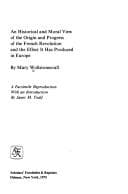
An historical and moral view of the origin and progress of the French Revolution; and the effect it has produced in EuropeWollstonecraft, Mary
Philosophy
An historical and moral view of the origin and progress of the French Revolution; and the effect it has produced in Europe
Wollstonecraft, Mary
France -- History -- Revolution, 1789-1799 -- Causes
Such are the opposite sentiments, or rather conduct of court parasites,
and men struggling to be free, that it is sufficient to contrast them.
The deputies, whose lives had been threatened, and their persons grossly
insulted, not only excused the ill advised monarch for the countenance
which he had given to the violation of the most sacred principles; but
expressed a conciliatory disposition to all parties. The mob, it is
true, in the heat of rage, inhumanly butchered two of the vile
instruments of despotism. But this violence offered to justice ought not
to be attributed to the temper of the people, much less to the
connivance of the national assembly, who acted with a degree of
magnanimity, at this time, of which it can never be enough lamented that
they have since lost sight. The behaviour however of the hardened
children of oppression in all countries is the same; whether in the
amphitheatre at Rome, or around the lantern-post in Paris.
The king’s eldest brother alone remained with the court, a man with more
resources of understanding in himself, than the rest of his family; yet,
making it a point of honour to be treated like his younger brother the
count d’Artois, he contributed by his rapacity to drain the royal
treasure, though such an expensive variety of amusements was not
necessary to give a zest to his pleasures.
The noble depredators had now escaped; yet Foulon, the minister, the
most desperate and pusillanimous of the gang, was taken, in spite of his
mock funeral.—I purposely use the word gang; for a squeamish delicacy
with respect to terms makes us sometimes confound characters to such a
degree, that the great villain is not stigmatized with the epithet
associated with the idea of a gallows; because, by the grossest
subversion of reason, the aggravation of guilt has so palliated the
punishments, that the head, which would have disgraced a halter, has
been respectfully severed on a block.
Once seized, no authority could prevent the murder of this miserable
wretch; and the same evening the intendant of Paris, his son-in-law, met
a death still more shocking, being prolonged by the humane interposition
of the respectable mayor, and La Fayette, in his favour.
Public-domain text, read in full here on John Shaqi.
Reviews
Reviews
No reviews yet
Be the first to share your thoughts on this work.
Elsewhere in the archive
Join the Discussion
Join the discussion
Sign in to leave a comment or review.
Sign InorCreate an account