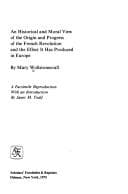
An historical and moral view of the origin and progress of the French Revolution; and the effect it has produced in EuropeWollstonecraft, Mary
Philosophy
An historical and moral view of the origin and progress of the French Revolution; and the effect it has produced in Europe
Wollstonecraft, Mary
France -- History -- Revolution, 1789-1799 -- Causes
New conspiracies were already formed on the borders of France, by the
princes, and those who had subsisted by the corruptions of the old
system. But this only proved a stimulus; because the nation, being
determined to secure the rights it had so suddenly regained, raised new
regiments in every part of the country, and was soon in a situation to
repel any attack, which it was possible for all Germany to have made;
the only quarter from which the fugitive princes, at that period, could
expect assistance. So rapid was the spirit, so general the momentum,
that in the course of a week upwards of three millions of men in arms
were formed into companies by a common interest resembling an electrical
sympathy. Such was the quick succession of events—Such the unanimous
sense of the nation; and such the formidable force which instantly
opposed itself to the impotent threats of departing despotism. History
will record this memorable era, when the disciplined forces of the most
puissant tyranny vanished before the force of truth, though still but
half unveiled; obliging the haughty sycophants to search for shelter in
the recesses of a forest, whither they stole under cover of the night
from the presence of an injured people.
The conduct of the _garde-bourgeoise_, during the progress of the
revolution, without varnishing over the excesses produced by ebullitions
of zeal, is of itself sufficient to prove, that a national militia
should every where take place of standing armies, did not experience
invariably attest, that the laws were never respected by men, whose
business is war, unless they are reduced to mere machines by despotism.
The old municipal officers, mostly suspected, because nominated by the
friends of the court, were now obliged to give place to committees
elected by the common voice. These taking the administration of public
business into their hands, a new order of things began every where to
prevail. Still, however, the disturbed imagination of the people was
filled with plots, to which some mysterious and fatal incidents gave
life.
The municipality of Soissons informed the national assembly, that troops
of banditti had cut down the corn before it was ripe, and obliged the
villagers to take refuge in the towns. But on further inquiry, it
appeared, that this report arose from a simple quarrel of the peasants
amongst themselves, which had alarmed some labourers, who flew to the
neighbouring town, imagining that they had thousands of banditti at
their heels.
Paris was also disturbed by an idle rumour of a riot at St. Denis; so
seriously affirmed by those, who declared that they had been
eye-witnesses of the violence, that troops and cannon were sent, but
they could find no traces of the disturbance.
Public-domain text, read in full here on John Shaqi.
Reviews
Reviews
No reviews yet
Be the first to share your thoughts on this work.
Elsewhere in the archive
Join the Discussion
Join the discussion
Sign in to leave a comment or review.
Sign InorCreate an account