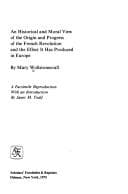
An historical and moral view of the origin and progress of the French Revolution; and the effect it has produced in EuropeWollstonecraft, Mary
Philosophy
An historical and moral view of the origin and progress of the French Revolution; and the effect it has produced in Europe
Wollstonecraft, Mary
France -- History -- Revolution, 1789-1799 -- Causes
In all civil wars, personal vengeance mixing with public, or taking
advantage of it, has directed the dagger of the assassin: and in France
it ought particularly to have been dreaded; because, when fear induces a
man to smother his just resentment, the festering wound is only to be
cured by revenge. It is then highly probable, that most of the
barbarities in the towns were the effervescence of private anger, or the
sport of depraved, uncultivated minds, who found the same pleasure in
tormenting men, as mischievous boys in dismembering insects; for public
indignation, directed against aristocratical tyranny, was elsewhere, in
general, displayed only in burning the country castles, and the archives
of nobility. But, in the country, indeed, men rarely commit such crimes,
as lift up their reptile heads in the capital, where the rank atmosphere
affords the noxious particles necessary to give virulence to the poison.
The vices of villagers are, in fact, rather the rich exuberance of the
passions, than the vile dregs of exhausted nature.
CHAPTER II.
THE DUKE OF LIANCOURT CHOSEN PRESIDENT. THE PEOPLE ARM FOR THE DEFENCE
OF THE COUNTRY. THE MUNICIPAL OFFICERS APPOINTED UNDER THE OLD
GOVERNMENT SUPERSEDED BY COMMITTEES. SOME PEOPLE TREACHEROUSLY DESTROYED
BY SPRINGING A MINE AT A CIVIC FEAST. THE GENEVESE RESIDENT TAKEN UP BY
THE PATROL. THE FRENCH SUSPICIOUS OF THE DESIGNS OF BRITAIN. NECKER
RETURNS. GENERAL AMNESTY RESOLVED BY THE ELECTORS OF PARIS. DEBATE ON A
DECLARATION OF RIGHTS. DECLARATION OF RIGHTS SEPARATE FROM THE
CONSTITUTION DETERMINED ON. SACRIFICES MADE BY THE NOBLES, CLERGY, &C.
The duke of Liancourt, whose warning voice had made the king look around
him, when danger was at his heels, was now chosen president. At this
moment the obstacles, which at first clogged the exertions of the
assembly, seemed to have been overcome: still fresh ones starting up
threw a damp on their exultation; and the apprehensions of a famine,
real or factitious, were not the least alarming, though the most
frequent.
Public-domain text, read in full here on John Shaqi.
Reviews
Reviews
No reviews yet
Be the first to share your thoughts on this work.
Elsewhere in the archive
Join the Discussion
Join the discussion
Sign in to leave a comment or review.
Sign InorCreate an account