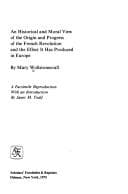
An historical and moral view of the origin and progress of the French Revolution; and the effect it has produced in EuropeWollstonecraft, Mary
Philosophy
An historical and moral view of the origin and progress of the French Revolution; and the effect it has produced in Europe
Wollstonecraft, Mary
France -- History -- Revolution, 1789-1799 -- Causes
The debates respecting the adoption of the declaration of rights became
very spirited; and much heterogeneous matter was introduced, to lengthen
the discussion, and heat the disputants, as the different articles were
reviewed. The article respecting religion particularly arrested the
attention of the assembly, and produced one of those tumultuous scenes,
which have so often disgraced their deliberations. The intolerant
sentiments uttered; and even the insertion of some amendments, which
could not, without a contradiction in terms, find a place in a
declaration of rights; proved, that the assembly contained a majority,
who were still governed by prejudices inimical to the full extent of
that liberty, which is the unalienable right of each citizen, when it
does not infringe on the equal enjoyment of the same portion by his
neighbour[29]. The most sensible part of the assembly asserted, that
religion ought not to be mentioned, unless to declare, that the free
exercise of it was a right in common with the free utterance of all
opinions; which came under civil cognizance only when they assumed a
form, namely, when they produced effects, that clashed with the laws;
and even then it was the criminal action, not the passive opinion, which
was proscribed by the penalty of punishment.
In this declaration are found the principles of political and civil
liberty, introduced by a very solemn exordium:—Declaring ‘that, as
ignorance, forgetfulness, and contempt of the rights of men, are the
sole causes of public grievances, and of the corruption of governments,
the assembly had resolved to re-establish, in a solemn declaration, the
natural, imprescriptible, and sacred rights of man; in order that this
declaration, constantly present to all the members of the social body,
may continually remind them of their rights, and of their duties; that,
having it in their power every moment to compare the acts of the
legislative and executive authorities with the purpose of all political
institutions, they may the more respect them; and that the remonstrances
of the citizens, founded, in future, on simple and incontestible
principles, may always tend to support the constitution, and to promote
the happiness of the whole community.’
Some temporary business, towards restoring public tranquillity, and to
give force to the laws, insulted by the licentious conduct of men
inebriated merely by the expectation of freedom, scented from afar,
being dispatched, the formation of a constitution became the standing
labour of the assembly.
Public-domain text, read in full here on John Shaqi.
Reviews
Reviews
No reviews yet
Be the first to share your thoughts on this work.
Elsewhere in the archive
Join the Discussion
Join the discussion
Sign in to leave a comment or review.
Sign InorCreate an account