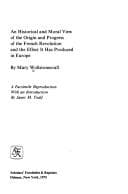
An historical and moral view of the origin and progress of the French Revolution; and the effect it has produced in EuropeWollstonecraft, Mary
Philosophy
An historical and moral view of the origin and progress of the French Revolution; and the effect it has produced in Europe
Wollstonecraft, Mary
France -- History -- Revolution, 1789-1799 -- Causes
The foundation of liberty was laid in the declaration of rights; the
first three articles of which contain the great principles of natural,
political, and civil liberty.—First, that men are born, and always
continue, free, and equal in respect to their rights:—civil
distinctions, therefore, can be founded only on public utility.
Secondly, the end of all political associations is the preservation of
the natural and imprescriptible rights of man: which rights are—liberty,
property, security, and resistance of oppression. Thirdly, the nation is
the source of all sovereignty: no body of men, no individual, can then
be entitled to any authority, which is not derived from it. The first
article, establishing the equality of man, strikes at the root of all
useless distinctions:—the second, securing his rights against
oppression, maintains his dignity:—and the third, acknowledging the
sovereignty of the nation, confirms the authority of the people.—These
are the essential points of a good government: and it is only necessary,
when these points are ascertained by a nation, and solemnly ratified in
the hearts of it’s citizens, to take care, in the formation of a
political system, to provide against the abuse of the executive part;
whilst equal caution should be observed, not to destroy it’s efficiency,
as on that depend it’s justice, vigour, and promptitude. The other
articles are explanatory of the nature and intent of these rights, and
ought to have had more attention paid to them, when the structure was
raised, to which they served as a basis.
Whilst defining the authority of the king, or rather determining, that
he should have no authority, unless the option of disturbing the
legislation deserve that name, they debated the question of two chambers
with equal inconsideration, and all the puerile self-sufficiency of
ignorance. The opposers of two chambers, without allowing, that there
was any political wisdom in appointing one house of representatives to
reconsider the resolves of the other, ridiculed the idea of a balance of
power, and instanced the abuses of the english government to give force
to their objections. At the same time fearing, that the nobles of the
court would contend for an hereditary senate, similar to the british
house of peers; or, at least, for a seat during life, paramount to the
representatives who they determined should be elected every two years;
they fought to bring the business to a speedy issue. The very division
of the nobility served to hasten it, and strengthened the arguments of
the popular members; who finding that they could rely on the concurrence
of the parish-priests, whose wishes in favour of the unity of the
assembly were quickly betrayed by the opinions of their leading orators,
demanded the decision of a question, that had been agitated in the most
tumultuous manner.
Public-domain text, read in full here on John Shaqi.
Reviews
Reviews
No reviews yet
Be the first to share your thoughts on this work.
Elsewhere in the archive
Join the Discussion
Join the discussion
Sign in to leave a comment or review.
Sign InorCreate an account