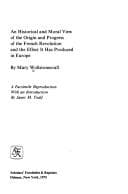
An historical and moral view of the origin and progress of the French Revolution; and the effect it has produced in EuropeWollstonecraft, Mary
Philosophy
An historical and moral view of the origin and progress of the French Revolution; and the effect it has produced in Europe
Wollstonecraft, Mary
France -- History -- Revolution, 1789-1799 -- Causes
There were besides many circumstances, which tended to make any attempt
to counteract this influence very difficult. At the meeting of the
states-general, the whole court party, with the greater proportion of
both the nobility and clergy, were in opposition to the third-estate:
and though the number of the latter was equal to that of the other two
orders, they had also to contend with the inveterate prejudices of ages.
The court had thought only of devising means to crush them; and had the
soldiery acted with the blind zeal common to men of this profession, it
would of itself have been sufficient to have completely disconcerted
their views. This conduct of the cabinet, and the discovery of the
atrocious conspiracy, which had been formed against the people and their
idolized representatives, provoking the resentment and vengeance of the
nation, palsied all authority, and rendered the laws that had emanated
from it contemptible. To oppose this torrent of opinions, like an
impetuous current, that after heavy rains, defying all resistance, bears
away on it’s raging bosom every obstacle, required the most enlightened
prudence and determined resolution.
So much wisdom and firmness seldom fall to the lot of any country: and
it could scarcely have been expected from the depraved and volatile
french; who proudly, or ignorantly, determining to follow no political
track, seem to have fixed on a system proper only for a people in the
highest stage of civilization;—a system of itself calculated to
disorganize the government, and throw embarrassments into all it’s
operations. This was an errour so gross, as to demand the severest
animadversions. For this political plan, ever considered as utopian by
all men who had not traced the progress of reason, or calculated the
degree of perfectibility the human faculties are capable of attaining,
was, it might be presumed, the most improper for the degenerate society
of France. The exertions of the very admirers of the revolution were,
likewise, far from being permanent; and they could hardly have been
expected to possess sufficient virtue to support a government, the
duration of which they at least feared would be short. The men termed
experienced believed it physically impossible; and no arguments were
cogent enough to convince them of the contrary: so that, they leaving
the task to mock patriots and enthusiasts, a fresh odium has been thrown
on principles, which, notwithstanding are gaining ground. Things must be
left to their natural course; and the accelerating progress of truth
promises to demonstrate, what no arguments have hitherto been able to
prove.
Public-domain text, read in full here on John Shaqi.
Reviews
Reviews
No reviews yet
Be the first to share your thoughts on this work.
Elsewhere in the archive
Join the Discussion
Join the discussion
Sign in to leave a comment or review.
Sign InorCreate an account