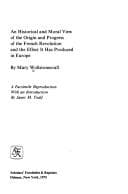
An historical and moral view of the origin and progress of the French Revolution; and the effect it has produced in EuropeWollstonecraft, Mary
Philosophy
An historical and moral view of the origin and progress of the French Revolution; and the effect it has produced in Europe
Wollstonecraft, Mary
France -- History -- Revolution, 1789-1799 -- Causes
The deputies, who opposed the upper chamber to promote the good of
society, did it from a belief, that it would be the asylum of a new
aristocracy; and from a total ignorance, or obscurity of ideas,
respecting it’s utility. Whilst the oppressions of the feudal system
being still present to the minds of the people, they considered a
division of the legislative body as inconsistent with the freedom and
equality they were taught to expect as the prime blessings of a new
constitution. The very mention of _two chambers_ carried them back to
the old dispute, respecting the negative of the different orders; and
seemed to subvert the revolution. Such fears, degenerating into
weakness, can only be accounted for by recollecting the many cruel
thraldoms, from which they had so recently escaped. Besides, the
remembrance of their former servitude, and the resentment excited by the
late struggle to prove they were men, created in their enthusiastic
imaginations such a multitude of horrours, and fantastic images of new
dangers, as did not allow them to exercise the full powers of their
reason. So that to convince them of the propriety of a new institution,
and heat the supporters of it, nothing more was necessary, than to show,
that it was the very reverse of those maintained by the partizans of the
old government.
The wisdom of giving to the executive part of a government an absolute
_veto_ might very justly have been questioned; as it seems to be giving
a power to one man to counteract the will of a whole people—an absurdity
too gross to merit refutation. Still, whilst crowns are a necessary
bauble to please the multitude, it is also necessary, that their
dignity, should be supported, in order to prevent an overweening
aristocracy from concentrating all authority in themselves. This seems
to have been expedient, likewise, as long as the manners of barbarians
remained: as savages are naturally pleased with glass and beads, in
proportion as they afford a striking contrast to the rude materials of
their own fabrication.
Public-domain text, read in full here on John Shaqi.
Reviews
Reviews
No reviews yet
Be the first to share your thoughts on this work.
Elsewhere in the archive
Join the Discussion
Join the discussion
Sign in to leave a comment or review.
Sign InorCreate an account