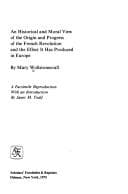
An historical and moral view of the origin and progress of the French Revolution; and the effect it has produced in EuropeWollstonecraft, Mary
Philosophy
An historical and moral view of the origin and progress of the French Revolution; and the effect it has produced in Europe
Wollstonecraft, Mary
France -- History -- Revolution, 1789-1799 -- Causes
‘How will our courage in the exercise of the functions, you have
confided to us, be renewed! With what vigour shall we labour in forming
the constitution, when secured from interruption! We have sworn to save
our country—judge of our anguish, whilst it trembles on the verge of
destruction. A momentary sacrifice is sufficient; a sacrifice offered to
the public good, and not to the encroachments of covetousness. And is
this easy expiation of the faults and blunders of a period, stigmatized
by political servitude, above our strength? Think of the price which has
been paid for liberty by other nations, who have shown themselves worthy
of it:—for this, rivers of blood have streamed—long years of woe, and
horrid civil wars, have every where preceded the glorious birth!—Of us
nothing is required, but a pecuniary sacrifice—and even this vulgar
offering is not an impoverishing gift:—it will return into our bosom, to
enrich our cities, our fields; augmenting our national glory and
prosperity.’
CHAPTER III.
REFLECTIONS ON THE NEW MODE OF RAISING SUPPLIES. NO JUST SYSTEM OF
TAXATION YET ESTABLISHED. PAPER MONEY. NECESSITY OF GRADUAL REFORM.
The task certainly was very difficult, at this crisis, for a minister to
give satisfaction to the people, and yet supply the wants of the state;
for it was not very likely that the public, who had been exclaiming
against the incessant demands of the old government, would have been
pleased with new burdens, or patiently endured them. Still it is always
the height of folly in a financier, to attempt to supply the exigencies
of government by any but specific and certain means: for such vague
measures will ever produce a _deficit_, the consequences of which are
most pernicious to public credit and private comfort.
A man, who has a precise sum to live upon, generally takes into his
estimate of expences a certain part of his income as due to the
government, for the protection and social advantages it secures him.
This proportion of his income being commonly the same from period to
period, he lays it by for that particular purpose, and contentedly
enjoys the remainder. But, should a weak minister, or a capricious
government, call on him for an additional sum, because the taxes have
proved unproductive, either through the inability of some of the members
of the state, or that they were laid on articles of consumption, and the
consumption has not been equal to the calculation; it not only deranges
his schemes of domestic economy, but may be the cause of the most
serious inconvenience.
Public-domain text, read in full here on John Shaqi.
Reviews
Reviews
No reviews yet
Be the first to share your thoughts on this work.
Elsewhere in the archive
Join the Discussion
Join the discussion
Sign in to leave a comment or review.
Sign InorCreate an account