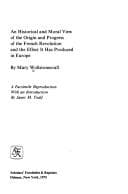
An historical and moral view of the origin and progress of the French Revolution; and the effect it has produced in EuropeWollstonecraft, Mary
Philosophy
An historical and moral view of the origin and progress of the French Revolution; and the effect it has produced in Europe
Wollstonecraft, Mary
France -- History -- Revolution, 1789-1799 -- Causes
A man who has a limited income, and a large family, is not only obliged
to be very industrious to support them, but he is likewise necessitated
to make all his arrangements with the greatest circumspection and
exactness; because a trifling loss, by involving him in debt, might lead
to his ruin, including that of his family. The rich man, indeed, seldom
thinks of these most cruel misfortunes; for a few pounds, more or less,
are of no real importance to him. Yet the poor man, nay even the man of
moderate fortune, is liable to have his whole scheme of life broken by a
circumstance of this kind, and all his future days embittered by a
perpetual struggle with pecuniary vexations.
Governments, which ought to protect, and not oppress mankind, cannot be
too regular in their demands; for the manner of levying taxes is of the
highest importance to political economy, and the happiness of
individuals. No government has yet established a just system of
taxation[31]: for in every country the expences of government have
fallen unequally on the citizens; and, perhaps, it is not possible to
render them perfectly equal, but by laying all the taxes on land, the
mother of every production.
In this posture of affairs, the enthusiasm of the french in the cause of
liberty might have been turned to the advantage of a new and permanent
system of finance. An able, bold minister, who possessed the confidence
of the nation, might have recommended with success the taking of the
national property under the direct management of the assembly; and then
endeavouring to raise a loan on that property, he would have given
respectability to the new government, by immediately procuring the
supplies indispensably necessary not only to keep it, but to put it in
motion.
In times of civil commotion, or during a general convulsion, men who
have money, and they are commonly most timid and cautious, are very apt
to take care of it, even at the expence of their interest; and,
therefore, it was to be presumed, that the monied men of France would
not have been very ready to subscribe to the different loans proposed by
the minister, unless the security had been obvious, or the speculative
advantages exorbitant. But if Necker, whom the prudent usurer adored as
his tutelar god, had said to the nation ‘there is a property worth
4,700,000,000 _l._ independent of the property of the emigrants, take it
into your immediate possession; and, whilst the sales are going on, give
it as a guarantee for the loan you want. This just and dignified measure
will not only relieve your present necessities, but it will be
sufficient to enable you to fulfil great part of your former
engagements.’ There would have been then no need of the eloquence of
Mirabeau; reason would have done the business; and men, attending to
their own interest, would have promoted the public good, without having
their heads turned giddy by romantic flights of heroism.
Public-domain text, read in full here on John Shaqi.
Reviews
Reviews
No reviews yet
Be the first to share your thoughts on this work.
Elsewhere in the archive
Join the Discussion
Join the discussion
Sign in to leave a comment or review.
Sign InorCreate an account