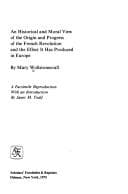
An historical and moral view of the origin and progress of the French Revolution; and the effect it has produced in EuropeWollstonecraft, Mary
Philosophy
An historical and moral view of the origin and progress of the French Revolution; and the effect it has produced in Europe
Wollstonecraft, Mary
France -- History -- Revolution, 1789-1799 -- Causes
The immediate and incessant wants of a state must always be supplied;
prudence therefore, requires, that the directors of the finances should
rather provide by anticipation for it’s wants than suffer a _deficit_.
The government being once in arrears, additional taxes become
indispensable to bring forward the balance, or the nation must have
recourse to paper notes; an expedient, as experience has shown, always
to be dreaded, because by increasing the debt it only extends the evil.
And this increasing debt, like a ball of snow, gathering as it rolls,
soon attains a wonderful magnitude. Every state, which has unavoidably
accumulated it’s debt, ought, provided those at the helm wish to
preserve the government, and extend the security and comforts of it’s
citizens, to take every just measure to render the interest secure, and
to fund the principal; for as it augments, like the petrifying mass, it
stands in the way of all improvement, spreading the chilling miseries of
poverty around—till the evil baffling all expedients, a mighty crash
produces a new order of things, overwhelming, with the ruins of the old,
thousands of innocent victims.
The precious metals have been considered as the best of all possible
signs of value, to facilitate the exchange of commodities, to supply our
reciprocal wants: and they will ever be necessary to our comfort, whilst
by the common consent of mankind they are the standards of exchange.
Gold and silver have a specific value, because it is not easy to
accumulate them beyond a certain quantity. Paper, on the contrary, is a
dangerous expedient, except under a well established government: and
even then the business ought to be conducted with great moderation and
sagacity.—Perhaps it would be wise, that it’s extent should be
consistent with the commerce of the country, and the quantity of species
actually in it—But it is the spirit of commerce to stretch credit too
far. The notes, also, which are issued by a state before it’s government
is well established, will certainly be depreciated; and in proportion as
they grow precarious, the gold and silver, which was formerly in
circulation will vanish, and every article of trade, and all the
comforts of life, will bear a higher price.
These are considerations, which ought to have occurred to the french
minister, and have led him to take decided measures. The interest of the
national debt was 255,395,141 _l._ by a report for the year
1792.—Necker, by his account dated the 1st of may, 1789, states the
income at 475,294,000 _l._, and the expences at 531,533,000 _l._:
consequently there was a deficiency of 56,239,000 _l._; and it was not
probable, it could not even be expected, that during the convulsions of
a revolution, the taxes would be regularly paid: the debt, then, and the
demands of the state, must increase.
Public-domain text, read in full here on John Shaqi.
Reviews
Reviews
No reviews yet
Be the first to share your thoughts on this work.
Elsewhere in the archive
Join the Discussion
Join the discussion
Sign in to leave a comment or review.
Sign InorCreate an account