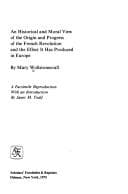
An historical and moral view of the origin and progress of the French Revolution; and the effect it has produced in EuropeWollstonecraft, Mary
Philosophy
An historical and moral view of the origin and progress of the French Revolution; and the effect it has produced in Europe
Wollstonecraft, Mary
France -- History -- Revolution, 1789-1799 -- Causes
When their heads were heated by a sumptuous banquet, by the tumult of an
immense crowd, and the great profusion of delicious wines and
_liqueurs_, the conversation, purposely turned into one channel, became
unrestrained, and a chivalrous scene completed the folly. The queen, to
testify her satisfaction for the homage paid to her, and the wishes
expressed in her favour, exhibited herself to this half-drunken
multitude; carrying the dauphin in her arms, whom she regarded with a
mixture of sorrow and tenderness, and seeming to implore in his favour
the affection and zeal of the soldiers.
This acting, for it is clear that the whole was a preconcerted business,
was still more intoxicating than the wine.—The exclamation _vive le roi,
vive la reine_, resounded from all sides, and the royal healths were
drunk over drawn swords, whilst that of the nation was rejected with
contempt by the body-guards. The music, the choice could not have been
the effect of chance, played the well known air—O Richard! O my king!
the universe abandons thee[32]! and during this moment of fascination
some voices, perhaps bribed for the occasion, mingled execrations
against the assembly. A grenadier even darted from the midst of his
comrades, and accusing himself of having been unfaithful to his prince,
endeavoured, several times, to plunge his sword into his bosom. His held
arm was not indeed allowed to search for the disloyal heart; but some
blood was permitted to flow—and this theatrical display of sensibility,
carried to the highest pitch, produced emotions almost convulsive in the
whole circle, of which an english reader can scarcely form an idea. The
king, who is always represented as innocent, though always giving proofs
that he more than connived at the attempts to recover his power, was
likewise prevailed on to show himself at this entertainment. And some of
the same soldiery, who had refused to second the former project of the
cabal, were now induced to utter insults and menaces against the very
authority, they then supported. ‘The national cockade,’ exclaimed
Mirabeau, ‘that emblem of the defenders of liberty, has been torn in
pieces, and stamped under foot; and another ensign put in it’s
place.—Yes; even under the eye of the monarch, who allowed himself to be
styled—_Restorer of the rights of his people_, they have dared to hoist
a signal of faction.’
The same scene was renewed two days after, though with less parade; and
invitations for a similar treat were given for the following week.
Public-domain text, read in full here on John Shaqi.
Reviews
Reviews
No reviews yet
Be the first to share your thoughts on this work.
Elsewhere in the archive
Join the Discussion
Join the discussion
Sign in to leave a comment or review.
Sign InorCreate an account