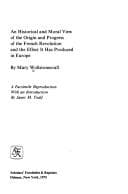
An historical and moral view of the origin and progress of the French Revolution; and the effect it has produced in EuropeWollstonecraft, Mary
Philosophy
An historical and moral view of the origin and progress of the French Revolution; and the effect it has produced in Europe
Wollstonecraft, Mary
France -- History -- Revolution, 1789-1799 -- Causes
The melioration of the old government of France arose entirely from a
degree of urbanity acquired by the higher class, which insensibly
produced, by a kind of natural courtesy, a small portion of civil
liberty. But, as for political liberty, there was not the shadow of it;
or could it ever have been generated under such a system: because,
whilst men were prevented not only from arriving at public offices, or
voting for the nomination of others to fill them, but even from
attaining any distinct idea of what was meant by liberty in a practical
sense, the great bulk of the people were worse than savages; retaining
much of the ignorance of barbarians, after having poisoned the noble
qualities of nature by imbibing some of the habits of degenerate
refinement. To the national assembly it is, that France is indebted for
having prepared a simple code of instruction, containing all the truths
necessary to give a comprehensive perception of political science; which
will enable the ignorant to climb the mount of knowledge, whence they
may view the ruins of the ingenious fabric of despotism, that had so
long disgraced the dignity of man by it’s odious and debasing claims.
The declaration of rights contains an aggregate of principles the most
beneficial; yet so simple, that the most ordinary capacity cannot fail
to comprehend their import. It begins by asserting, that the rights of
men are equal, and that no distinctions can exist in a wholesome
government, but what are founded on public utility. Then showing, that
political associations are intended only for the preservation of the
natural and imprescriptible rights of man, which are his liberty,
security of property, and resistance against oppression; and asserting
also, that the nation is the source of all sovereignty; it delineates,
in a plain and perspicuous manner, in what these rights, and this
sovereignty, consist. In this delineation men may learn, that, in the
exercise of their natural rights, they have the power of doing whatever
does not injure another; and that this power has no limits, which are
not determined by law—the laws being at the same time an expression of
the will of the community, because all the citizens of the state, either
personally, or by their representatives, have a right to concur in the
formation.
Thus, having taught the citizens the fundamental principles of a
legitimate government, it proceeds to show how the opinion of each may
be ascertained; which he has a right to give personally, or by his
representatives, to determine the necessity of public contributions,
their appropriation, mode of assessment, and duration.
Public-domain text, read in full here on John Shaqi.
Reviews
Reviews
No reviews yet
Be the first to share your thoughts on this work.
Elsewhere in the archive
Join the Discussion
Join the discussion
Sign in to leave a comment or review.
Sign InorCreate an account