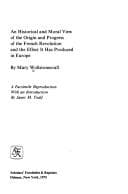
An historical and moral view of the origin and progress of the French Revolution; and the effect it has produced in EuropeWollstonecraft, Mary
Philosophy
An historical and moral view of the origin and progress of the French Revolution; and the effect it has produced in Europe
Wollstonecraft, Mary
France -- History -- Revolution, 1789-1799 -- Causes
The simplicity of these principles, promulged by the men of genius of
the last and present ages, and their justness, acknowledged by every
description of unprejudiced men, had not been recognised by any senate
or government in Europe; and it was an honour worthy to be reserved for
the representatives of twenty-five millions of men, rising to the sense
and feeling of rational beings, to be the first to dare to ratify such
sacred and beneficial truths—truths, the existence of which had been
eternal; and which required only to be made known, to be generally
acknowledged—truths, which have been fostered by the genius of
philosophy, whilst hereditary wealth and the bayonet of despotism have
continually been opposed to their establishment.
The publicity of a government acting conformably to the principles of
reason, in contradistinction to the maxims of oppression, affords the
people an opportunity, or at least a chance, of judging of the wisdom
and moderation of their ministers; and the eye of discernment, when
permitted to make known it’s observations, will always prove a check on
the profligacy or dangerous ambition of aspiring men.—So that in
contemplating the extension of representative systems of polity, we have
solid ground on which to rest the expectation—that wars and their
calamitous effects will become less frequent, in proportion as the
people, who are obliged to support them with their sweat and blood, are
consulted respecting their necessity and consequences.
Such consultations can take place under representative systems of
government only—under systems which demand the responsibility of their
ministers, and secure the publicity of their political conduct. The
mysteries of courts, and the intrigues of their parasites, have
continually deluged Europe with the blood of it’s most worthy and heroic
citizens, and there is no specific cure for such evils, but by enabling
the people to form an opinion respecting the subject of dispute.
The court of Versailles, with powers the most ample, was the most busy
and insidious of any in Europe; and the horrours which she has
occasioned, at different periods, were as incalculable, as her ambition
was unbounded, and her councils base, unprincipled, and dishonourable.
If, then, it were only for abolishing her sway, Europe ought to be
thankful for a change, that, by altering the political systems of the
most improved quarter of the globe, must ultimately lead to universal
freedom, virtue, and happiness.
Public-domain text, read in full here on John Shaqi.
Reviews
Reviews
No reviews yet
Be the first to share your thoughts on this work.
Elsewhere in the archive
Join the Discussion
Join the discussion
Sign in to leave a comment or review.
Sign InorCreate an account