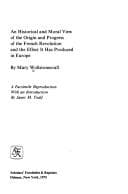
An historical and moral view of the origin and progress of the French Revolution; and the effect it has produced in EuropeWollstonecraft, Mary
Philosophy
An historical and moral view of the origin and progress of the French Revolution; and the effect it has produced in Europe
Wollstonecraft, Mary
France -- History -- Revolution, 1789-1799 -- Causes
But it is to be presumed, when the effervescence, which now agitates the
prejudices of the whole continent, subsides, the justness of the
principles brought forward in the declaration of the rights of men and
citizens will be generally granted; and that governments, in future,
acquiring reason and dignity, feeling for the sufferings of the people,
whilst reprobating the sacrilege of tyranny, will make it their
principal object, to counteract it’s baneful tendency, by restraining
within just bounds the ambition of individuals.
CHAPTER IV.
PROGRESS OF REFORM. THE ENCYCLOPEDIA. LIBERTY OF THE PRESS. CAPITALS.
THE FRENCH NOT PROPERLY QUALIFIED FOR THE REVOLUTION. SAVAGE COMPARED
WITH CIVILIZED MAN. EFFECTS OF EXTRAVAGANCE—OF COMMERCE—AND OF
MANUFACTURES. EXCUSE FOR THE FEROCITY OF THE PARISIANS.
People thinking for themselves have more energy in their voice, than any
government, which it is possible for human wisdom to invent; and every
government not aware of this sacred truth will, at some period, be
suddenly overturned. Whilst men in a savage state preserve their
independence, they adopt no regular system of policy, nor ever attempt
to digest their rude code of laws into a constitution, to ensure
political liberty. Consequently we find in every country, after it’s
civilization has arrived at a certain height, that the people, the
moment they are displeased with their rulers, begin to clamour against
them; and, finally rejecting all authority but their own will, in
breaking the shackles of folly or tyranny, they glut their resentment by
the mischievous destruction of the works of ages, only considering them
as the moments of their servitude.
From the social disposition of man, in proportion as he becomes
civilized, he will mingle more and more with society. The first interest
he takes in the business of his fellow-men is in that of his neighbour;
next he contemplates the comfort, misery, and happiness of the nation to
which he belongs, investigates the degree of wisdom and justice in the
political system, under which he lives, and, striding into the regions
of science, his researches embrace all human kind. Thus he is enabled to
estimate the portion of evil or good which the government of his country
produces, compared with that of others; and the comparison, granting him
superiour powers of mind, leads him to conceive a model of a more
perfect form.
This spirit of inquiry first manifests itself in hamlets; when his views
of improvement are confined to local advantages: but the approximation
of different districts leading to further intercourse, roads of
communication are opened, until a central or favourite spot becomes the
vortex of men and things. Then the rising spires, pompous domes, and
majestic monuments, point out the capital; the focus of information, the
reservoir of genius, the school of arts, the seat of voluptuous
gratification, and the hot-bed of vice and immorality.
Public-domain text, read in full here on John Shaqi.
Reviews
Reviews
No reviews yet
Be the first to share your thoughts on this work.
Elsewhere in the archive
Join the Discussion
Join the discussion
Sign in to leave a comment or review.
Sign InorCreate an account