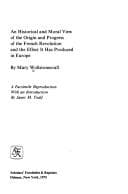
An historical and moral view of the origin and progress of the French Revolution; and the effect it has produced in EuropeWollstonecraft, Mary
Philosophy
An historical and moral view of the origin and progress of the French Revolution; and the effect it has produced in Europe
Wollstonecraft, Mary
France -- History -- Revolution, 1789-1799 -- Causes
Warmed by the discovery of this surreptitious attempt to cheat them into
blind obedience, they bound themselves by an oath, to act in concert;
and not to enregister a decree, that had been obtained through a medium,
which violated the privilege they had usurped of having a share in the
legislation, by rendering their sanction of edicts necessary to give
them force: a privilege that belonged only to the states-general. Still,
as the government had often found it convenient to make the parliaments
a substitute for a power they dreaded to see in action, these
magistrates sometimes availed themselves of this weakness, to
remonstrate against oppression; and thus, covering usurpation with a
respectable veil, the twelve parliaments were considered by the people
as the only barriers to resist the encroachments of despotism. Yet the
sagacious chancellor L’Hôpital, not deceived by their accidental
usefulness, guarded the french against their illegal ambition: for was
it not a dangerous courtesy of the people, to allow an aristocracy of
lawyers, who bought their places, to be as it were the only
representatives of the nation? Still their resistance had frequently
been an impediment in the way of tyranny, and now provoked a discussion,
which led to the most important of all questions—namely, in whose hands
ought the sovereignty to rest?—who ought to levy the impost, and make
laws?—and the answer was the universal demand of a fair representation,
to meet at stated periods, without depending on the caprice of the
executive power. Unable to effect their purpose by art or force, the
weak ministry, stung by the disappointment, determined at least to wreak
their vengeance on two of the boldest of the members. But the united
magistrates disputing the authority of the armed force, it was necessary
to send to Versailles, to make the king sign an express order; and
towards five o’clock the next morning the sanctuary of justice was
profaned, and the two members dragged to prison, in contempt of the
visible indignation of the people. Soon after, to fill up the measure of
provocations, a deputation sent by the province of Brittany, to
remonstrate against the establishment of the _cour pléniere_, were
condemned to silence in the Bastille.
Without money, and afraid to demand it, excepting in a circumlocutory
manner, the court, like mad men, spent themselves in idle exertions of
strength: for, whilst the citizens of Paris were burning in effigy the
two obnoxious ministers, who thus outraged them in the person of their
magistrates, they were delivered up to the fury of the hired slaves of
despotism, and trampled under foot by the cavalry; who were called in to
quell a riot purposely excited.
Public-domain text, read in full here on John Shaqi.
Reviews
Reviews
No reviews yet
Be the first to share your thoughts on this work.
Join the Discussion
Join the discussion
Sign in to leave a comment or review.
Sign InorCreate an account