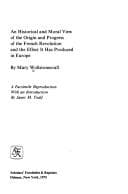
An historical and moral view of the origin and progress of the French Revolution; and the effect it has produced in EuropeWollstonecraft, Mary
Philosophy
An historical and moral view of the origin and progress of the French Revolution; and the effect it has produced in Europe
Wollstonecraft, Mary
France -- History -- Revolution, 1789-1799 -- Causes
Before we enter on the grand business produced by the meeting of the
states-general, it is necessary to take a retrospective glance over the
oppressions of which frenchmen so loudly complained; and, whilst we
trace their justness, the question will only be, why they did not sooner
raise their shoulders to heave off the mighty load. To ascertain this
truth, we need not enter into deep researches, though it may be
difficult to collect all the parts of the feudal chain, which linked the
despotism of sixty thousand nobles, who not only exercised all the
tyranny that the system authorized, but countenanced the still more
extensive depredations of their numerous dependents. What, indeed, could
equal the slavery of the poor husbandman; not only pillaged by the tythe
and game laws, but even obliged to let whole flocks of pigeons devour
his grain, without daring to destroy them, because those pigeons
belonged to the chateau; and afterwards forced to carry the scanty crop
to be tolled at the mill of _monseigneur_, which, to follow a
frenchman’s staff of life through all it’s stages of taxation, must then
be baked at the privileged oven?
It would be captious, perhaps, to dwell on some of the abominable
tenures of personal servitude, which, though grown obsolete, were not
abrogated; especially as more specious, if not less grinding, not less
debasing exactions were in force, to deprave every moral feeling of the
two divisions of society; the governing, and governed.
When chased from the country, of which the chief charm is independence,
by such worrying restraints, a man wished to pursue any occupation in a
town, he must previously purchase a patent of some privileged person, to
whom this tax had been sold by a farmer-general, or the parasite of a
minister.
All lived by plunder; and it’s universality gave it a sanction, that
took off the odium, though nothing could varnish the injustice. Yet,
such was the insensibility of the great, the pleasures these extortions
procured were not less grateful to the senses, because paid by the sweat
of industry.—No; like Vespasian’s obnoxious tax, money was money; and
who cared on what it was levied? Thus the rich necessarily became
robbers, and the poor thieves. Talking of honour, honesty was
overlooked; and, custom giving a soft name to different atrocities, few
thought it a duty to investigate disregarded principles; or to
relinquish their share of the plunder, to satisfy a romantic singularity
of opinion, which excited ridicule rather than imitation.
The military, a pest in every country, were here also all noble, and
leagued with a hundred thousand privileged persons, of different
descriptions, to support their prerogative of receiving a revenue, which
was a dead weight on agriculture; whilst they were not obliged, in a
direct way, to advance any thing towards defraying the public
expenditure.
Public-domain text, read in full here on John Shaqi.
Reviews
Reviews
No reviews yet
Be the first to share your thoughts on this work.
Join the Discussion
Join the discussion
Sign in to leave a comment or review.
Sign InorCreate an account