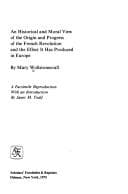
An historical and moral view of the origin and progress of the French Revolution; and the effect it has produced in Europe — John Shaqi
An historical and moral view of the origin and progress of the French Revolution; and the effect it has produced in EuropeWollstonecraft, Mary
Philosophy
An historical and moral view of the origin and progress of the French Revolution; and the effect it has produced in Europe
Wollstonecraft, Mary
France -- History -- Revolution, 1789-1799 -- Causes
There were also the farmers general, with their army of fifty thousand
collectors, who, by their manner of levying and amassing the revenue,
gave an additional gripe to an oppression, the most wringing that could
be invented, because it’s very principles led to the exercise of the
vilest peculation; and impunity was secured by a coalition of robbers,
that multitude of men in office, whose families and flatterers all
lived, and fattened on the spoil of their continual war with justice.
And, whilst the interest of the people was continually sacrificed by the
parliaments, the inferiour courts of law were still more venal, because
composed of those litigious practitioners, who thicken like spawn on
putrid bodies, when a state is become corrupt.
Such were the grievances!—Such the impositions, ‘that, taken together,
levied a tax on the kingdom,’ says Rabaud, ‘which the imagination is
afraid to calculate.’ This body of men we may consider as constituting
France, till the great bulk of the people, who were slaves and dwarfs,
bursting their shackles and rising in stature, suddenly appeared with
the dignity and pretentions of human beings: Yes; With the same
feelings; or perhaps stronger, because more natural; and claiming equal
rights with those nobles, who, like the giants of old, were only great
by the courtesy of the imagination. Who is so callous to the interest of
humanity as to say it was not a noble regeneration? Who is so benumbed
by selfish fears, as not to feel a glow of warmth, at seeing the
inhabitants of a vast empire exalted from the lowest state of beastly
degradation to a summit, where, contemplating the dawn of freedom, they
may breathe the invigorating air of independence; which will give them a
new constitution of mind? Who is so much under the influence of
prejudice, as to insist, that frenchmen are a distinct race, formed by
nature, or by habit, to be slaves; and incapable of ever attaining those
noble sentiments, which characterize a free people? When the dawn of
them appeared conspicuously at the elections for the states-general,
which were the preparatory struggles to make a change of opinion produce
an essential alteration in government.
Six millions of men were now in motion to choose the deputies, and
prepare their instructions; and in these assemblies the commons
commenced their political career; discussing, on new ground, subjects
that quickly became the only interesting topics throughout the kingdom.
In some few places, the three orders meeting together seemed to decide
the important question respecting the equality of the representatives
but, in general, the first two chambered themselves to guard tenaciously
their trembling prerogatives; and the third, with a cautious jealousy,
to demand the redress of grievances, which they could scarcely expect
the others to denominate by so harsh a name.
Public-domain text, read in full here on John Shaqi.
Reviews
Reviews
No reviews yet
Be the first to share your thoughts on this work.
Join the Discussion
Join the discussion
Sign in to leave a comment or review.
Sign InorCreate an account