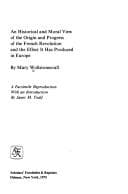
An historical and moral view of the origin and progress of the French Revolution; and the effect it has produced in Europe — John Shaqi
An historical and moral view of the origin and progress of the French Revolution; and the effect it has produced in EuropeWollstonecraft, Mary
Philosophy
An historical and moral view of the origin and progress of the French Revolution; and the effect it has produced in Europe
Wollstonecraft, Mary
France -- History -- Revolution, 1789-1799 -- Causes
The courtiers, despising their rusticity, and still considering the
people as ciphers, continued to discharge the usual routine of office,
by adjusting the ceremonials of reception; all which tended to insult
the third-estate, and show, that the deputies of the privileged orders
were to be still treated as if they were a distinct class of beings. The
insolence of such proceedings could not fail to provoke the honest
indignation, and pique the vanity of those, who had been discussing on a
broad scale the rights of man; whilst a little disconcerted by the
ceremony that constrained them, they were obliged, every moment, to
recollect, that they were the equals of these courtiers; and blushed
even to own to themselves, that they could for an instant have been awed
by such childish pomp. Nor were they more astonished at the pageantry of
Versailles, than disgusted with the haughtiness of a court, whose
magnificence was a proof how much they had impoverished the people, who
now demanded emancipation. Full, therefore, of the new notions of
independence, which made them spurn at every idea of a distinction of
men, they took advantage of the majority accorded them by the council,
and began to rally their forces. Perceiving also, as they acted
decidedly, that they possessed the confidence of the people, who,
forgetting _vive le roi_, exclaimed only vive le tiers-etat!—they every
day became more firm.
The courtiers immediately fixed on a house of rendezvous, where they
were regularly to concert the best measures to crush the rising power of
the commons; and these, not without a portion of the mistrust, which
characterizes the nation, assembled in different places, till a mutual
interest united them in that chosen by the deputies from Brittany. The
disrespect, likewise, which the orders relative to their dress
announced, prepared them for the contempt they were destined to receive,
when separated like the indian casts, amongst whom a man fears to be
polluted by the touch of an inferiour: for true to the inveterate
prejudice in favour of precedents[8], the nobility were gaudily
caparisoned for the show, whilst the commons were stupidly commanded to
wear the black mantle, that distinguishes the lawyers. But, the tide of
opinion once turned, every thing contributes to accelerate it’s course.
Public-domain text, read in full here on John Shaqi.
Reviews
Reviews
No reviews yet
Be the first to share your thoughts on this work.
Join the Discussion
Join the discussion
Sign in to leave a comment or review.
Sign InorCreate an account