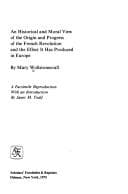
An historical and moral view of the origin and progress of the French Revolution; and the effect it has produced in EuropeWollstonecraft, Mary
Philosophy
An historical and moral view of the origin and progress of the French Revolution; and the effect it has produced in Europe
Wollstonecraft, Mary
France -- History -- Revolution, 1789-1799 -- Causes
The perfection attained by the ancients, it is true, has ever afforded
the imagination of the poetical historian a theme to deck with the
choicest flowers of rhetoric; though the cool investigation of facts
seems clearly to prove, that the civilization of the world, hitherto,
has consisted rather in cultivating the taste, than in exercising the
understanding. And were not these vaunted improvements also confined to
a small corner of the globe, whilst, the political view of the wisest
legislators seldom extending beyond the splendour and aggrandizement of
their individual nation, they trampled with a ferocious affectation of
patriotism on the most sacred rights of humanity? When the arts
flourished in Greece, and literature began to shed it’s blandishments on
society, the world was mostly inhabited by barbarians, who waged eternal
war with their more polished neighbours, the imperfection of whose
government sapping it’s foundation, the science of politics necessarily
received a check in the bud—and when we find, likewise, the roman empire
crumbling into atoms, from the germ of a deadly malady implanted in it’s
vitals; whilst voluptuousness stopped the progress of civilization,
which makes the perfection of the arts the dawn of science; we shall be
convinced, that it demanded ages of improving reason and experience in
moral philosophy, to clear away the rubbish, and exhibit the first
principles of social order.
We have probably derived our great superiority over those nations from
the discovery of the polar attraction of the needle, the perfection
which astronomy and mathematics have attained, and the fortunate
invention of printing. For, whilst the revival of letters has added the
collected wisdom of antiquity to the improvements of modern research,
the latter most useful art has rapidly multiplied copies of the
productions of genius and compilations of learning, bringing them within
the reach of all ranks of men: the scientific discoveries also have not
only led us to new worlds; but, facilitating the communication between
different nations, the friction of arts and commerce have given to
society the transcendently pleasing polish of urbanity; and thus, by a
gradual softening of manners, the complexion of social life has been
completely changed. But the remains of superstition, and the unnatural
distinction of privileged classes, which had their origin in barbarous
folly, still fettered the opinions of man, and sullied his native
dignity; till several distinguished english writers discussed political
subjects with the energy of men, who began to feel their strength; and,
whilst only a rumour of these sentiments roused the attention and
exercised the minds of some men of letters in France, a number of
staunch disputants, who had more thoroughly digested them, fled from
oppression, to put them to the test of experience in America.
Public-domain text, read in full here on John Shaqi.
Reviews
Reviews
No reviews yet
Be the first to share your thoughts on this work.
Join the Discussion
Join the discussion
Sign in to leave a comment or review.
Sign InorCreate an account