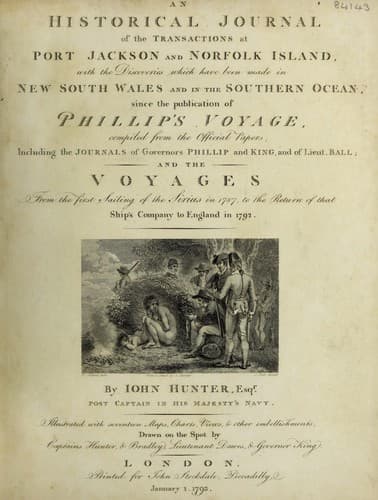
An Historical Journal of the Transactions at Port Jackson and Norfolk IslandHunter, John
History
An Historical Journal of the Transactions at Port Jackson and Norfolk Island
Hunter, John
New South Wales -- History -- Sources
All within Nepean Island is foul ground, and very irregular
soundings, and no safe passage between it and Point Hunter; but
if a ship should be pressed by necessity, I would recommend
keeping within half a cable's length of Nepean Island, after
having passed the bed of rocks to the westward of the little
bay.
Norfolk Island lies north-west by north and south-east by
south, and is in this direction about five miles long, and nearly
three in breadth; it is very thickly covered with wood, of which
there are six or seven different kinds, and some I believe might
be applied to naval purposes.
The Pines, which has been particularly spoken of by Captain
Cook, and by others, who have lately visited this island, is the
most conspicuous of any tree here; they grow to a prodigious
size, and are proportionably tall, being from 150 to 200 feet,
and in circumference from 12 to 14 feet, some to 28 and 30 feet.
These trees, from their immense height, have a very noble
appearance, being in general very straight, and free from
branches, to 40, sometimes 60 feet, above the ground; they have
been by some thought fit for masts, for ships of any size; in
length and diameter they certainly are, but with respect to
quality they are, in my opinion, wholly unfit; even admitting
them to be found, which, from experience, I know is seldom the
case.
I employed the carpenters of the Sirius, while here, to cut
down a few sticks, which it was intended should be sent home by
the first opportunity, in order for trial in his Majesty's
dock-yards, to see if they were, as had been said, fit for his
Majesty's navy, or not. In providing a top-mast and a
top-sail-yard for a seventy-four gun ship, a thirty-two, a
twenty, or a sloop, and one rough spar, in all seven sticks, 34
trees were cut down, 27 of which were found defective. When these
trees were falling, it was observed that most of them discharged
a considerable quantity of clear water, which continued to flow
at every fresh cut of the axe; there is no turpentine in these
trees but what circulates between the bark and body of the tree,
and which is soluble in water. It is a very short grained and
spongy kind of timber, and I think fit only for house-building,
for which we know it to be very useful.
When fresh cut down, five out of six will sink in water, the
wood is so exceedingly heavy: and, if we suppose for a moment,
that great part of the pine timber were fit for naval purposes,
the great difficulty, and indeed I may say impossibility, of
getting it from the interior parts of the island to the sea,
would render it of little value, if designed for masts; but if
for plank, it could be cut up where fallen. Those which grow on
the south-east point of the island, where the land is low, are
those which have hitherto been made use of.
Public-domain text, read in full here on John Shaqi.
Reviews
Reviews
No reviews yet
Be the first to share your thoughts on this work.
Elsewhere in the archive
Join the Discussion
Join the discussion
Sign in to leave a comment or review.
Sign InorCreate an account