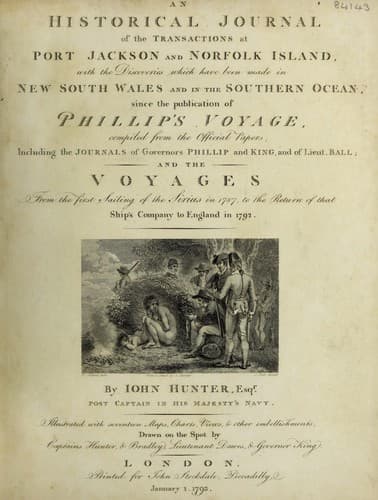
An Historical Journal of the Transactions at Port Jackson and Norfolk IslandHunter, John
History
An Historical Journal of the Transactions at Port Jackson and Norfolk Island
Hunter, John
New South Wales -- History -- Sources
We found the reef composed of a number of low islands or keys,
and many rocks above the water, and of considerable breadth; in
short, there was not the smallest hope of passing through it, the
sea broke very high on every part of it, which we could reach
with the eye from the mast-head. As soon as it was dark, and we
thought ourselves near enough to it, we tacked, and kept every
person upon deck during the night. We had, during the time we
were running to leeward and making observations on the coast,
passed by a number of low islands, covered with trees or shrubs,
and had observed they were all surrounded with a reef, which the
sea broke upon, and among these little islands were many reefs,
which appeared only by the breaking of the sea: we were then
thoroughly sensible of our mistake, and that the land which we
had taken from its extent to be a part of New Caledonia, was the
Isle of Pines; and that the height which we had steered down for,
and thought to be a part of the coast which Captain Cook had not
seen, was what he called the Prince of Wales's Foreland, and was
the farthest land he had seen to the westward.
We kept working to windward all night, between that extensive
reef to the westward, and those small keys and reefs which lay
between us and the land, and of which I have since observed,
Captain Cook, in his sketch, takes no notice; the outer reef he
marks, but leaves a large open space between it and the land,
which describes the reef to be a round cluster of rocks above and
under water: he probably had not an opportunity of observing this
dangerous place so near to the land as we had: there may be a
channel to the leeward between the inner end of this reef and the
shore, but it had very little the appearance of it; as we saw
many low shrubby islands between us and the shore, to which they
were probably connected by a reef under water, which, at the
distance we were from it, could not be ascertained.
At day-light in the morning of the 24th, we observed with no
small degree of pleasure, that we had gained ground to windward;
but this we knew was not owing to any weatherly qualities in the
ship, but to the wind having varied several points during the
night, and of which we had availed ourselves: by noon we were so
far to windward as to perceive the utmost extent of the reef to
the southward under our lee, and we had a prospect of weathering
it; we, of course, carried a press of sail, and did weather it
about two or three miles: when a-breast of it, the highest part
of the Isle of Pines was just to be seen above the horizon, which
was very clear, and it bore by compass north-east by north,
distant ten or eleven leagues; having passed without the reef, at
noon we observed our latitude to be 23 deg. 7' south, so that the
south extremity of this dangerous reef lies in latitude 23 deg.
00' south nearly: as soon as we were fairly clear of this
situation, we bore away to the westward.
Public-domain text, read in full here on John Shaqi.
Reviews
Reviews
No reviews yet
Be the first to share your thoughts on this work.
Elsewhere in the archive
Join the Discussion
Join the discussion
Sign in to leave a comment or review.
Sign InorCreate an account