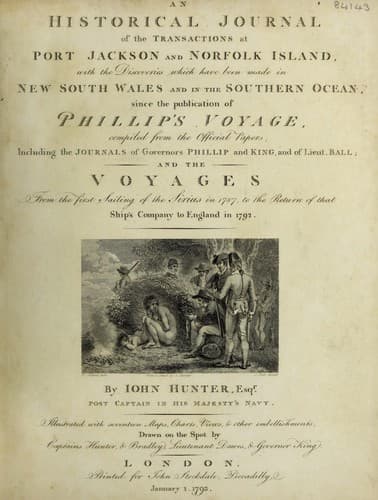
An Historical Journal of the Transactions at Port Jackson and Norfolk IslandHunter, John
History
An Historical Journal of the Transactions at Port Jackson and Norfolk Island
Hunter, John
New South Wales -- History -- Sources
And there is another error which I must take the liberty to
correct, and which also tended to deceive us; Point Carteret, in
the Swallow's sketch, is the extremity of the land westward,
which can be seen from a ship off Gower harbour, and the land
from that point inclines immediately to the northward; but there
is a point which lies north-west from Point Carteret, not less
than four miles, and from that point the land trends to the
northward: this point comes suddenly down from very high land to
a round bluff point, which is steep to, and Point Carteret is low
and woody. We discovered our mistake when it was too late to
recover it in such a vessel.
We ran along the shore close in, and endeavoured to find
anchorage; we had also a boat a-head for the same purpose, but
although we went sometimes within a cable's length of the shore,
we could not find bottom. Our situation now became serious, for
our water was become short, and we had yet a long voyage before
us; it was now absolutely necessary to look for some supply of
that article, and as we were only victualled for sixteen weeks
when we left Port Jackson, and had already been eight at sea, we
could not on that account lose much time, lest we should meet
with calms as we came near the Line. Full allowance of water, in
so sultry a climate, and so crowded a ship, was a matter which I
was exceedingly anxious about, for without a sufficiency of that
article, sickness amongst the people was much to be dreaded.
Before we went any farther to the northward, I was determined
to try the coast of New-Britain; we therefore stood over for that
land, intending, if possible, to find an anchoring place. On the
morning of the 22d, we came within three or four leagues of the
shore; it then fell calm, and the boat was sent in shore with Mr.
Keltie, the master of the Sirius, who had directions to make a
certain signal if he found anchorage: in the afternoon, a light
breeze sprung up, which enabled us to stand in and meet the boat.
Mr. Keltie reported, that the part of the coast which he had been
in with, was streight, and had no appearance of any sort of bay,
or the smallest probability of anchorage; that he had frequently
tried to get bottom within three cables length of the shore, but
without success. On this coast we found a regular tide, its
general direction was south-east and north-west.
The hills mentioned by Captain Carteret, on the coast of
New-Britain, by the name of the Mother and Daughters, are very
remarkable; a little way within the south-eastermost Daughter,
there is a small flat-top'd hill, or volcano, which all the time
we were within sight of it, emitted vast columns of black smoke.
On this coast there appeared many extensive spots of cleared, and
apparently cultivated land.
Public-domain text, read in full here on John Shaqi.
Reviews
Reviews
No reviews yet
Be the first to share your thoughts on this work.
Elsewhere in the archive
Join the Discussion
Join the discussion
Sign in to leave a comment or review.
Sign InorCreate an account