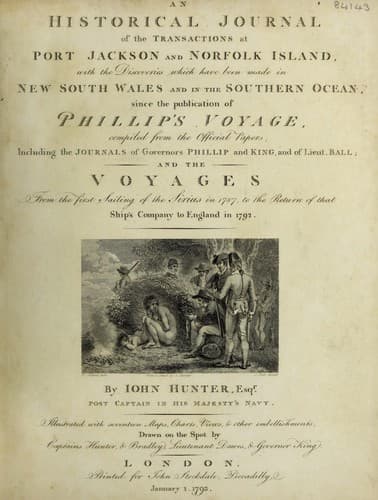
An Historical Journal of the Transactions at Port Jackson and Norfolk IslandHunter, John
History
An Historical Journal of the Transactions at Port Jackson and Norfolk Island
Hunter, John
New South Wales -- History -- Sources
When those people were disposed to be kind and friendly, they
frequently sung out in one particular tone, in which, if there
were five hundred together, the nicest ear could not discover one
to differ in the tone or particular note; and immediately after
they all mimicked the barking of a dog: this was meant by them as
a _certain proof_ of their friendly disposition. Before we
had cause to quarrel with them many came on board and were
shaved, an operation with which they were much pleased.
This island, by its appearance from the sea, I judged to be
about ten miles long, in a south-south-west and north-north-east
direction; it is not high, nor can it be called low land, but
appears, when near it, of moderate height and flat: it is well
covered with wood, and along the sea shore were to be seen many
huts of the natives, which were small and neatly made; they were
chiefly built of bamboo, and generally situated under the shade
of a grove of cocoa-nut trees, with a fence or railing before
them, within which the ground was well cleared and trodden, which
gave their little habitations a very neat and cleanly appearance:
I examined whilst we lay there several neat and well fenced
inclosures, in which were the plantain, banana, yam, sugar cane,
and several other articles, which they seem to take some pains to
cultivate.
In short, from what we could discover in the little time we
remained there, I may venture to pronounce the island a perfect
garden, as far as it can with propriety be called so in the hands
of a people, who, no doubt, trust chiefly to nature, and who are
ignorant of the means of assisting her, in the improvement of
those advantages, which she has so bountifully bestowed upon
them.
Although our time here was so short, we had an opportunity of
knowing that this island produced cocoa-nuts, yams, plantains,
bananas, sugar-cane, beetle-nut, mangos, bread-fruit, and guavas.
There are also dogs, hogs, and the common fowls, and some spices,
(the nutmeg I saw). Most of the natives chew the beetle, and with
it used the chenam and a leaf, as practised in the East-Indies;
by which the mouth appeared very red, and their teeth, after a
time, became black.
Their canoes were neatly made, and of various sizes, with an
out-rigger to balance them. I sent the carpenter of the Sirius on
shore, to examine the different kinds of timber; he reported to
me, that he found one tree which was hard, and had something like
the appearance of ebony, but was not quite so black; all the
others he tried were soft and spongy, like the palm or cabbage
tree.
The soil I think for richness beyond any I ever saw; it
exceeded Norfolk Island in that respect: I had a man with me who
had been upon that island from its first settlement, and who had
cleared and cultivated land there; he assured me that this was
superior to any he had ever opened at that island.
Public-domain text, read in full here on John Shaqi.
Reviews
Reviews
No reviews yet
Be the first to share your thoughts on this work.
Elsewhere in the archive
Join the Discussion
Join the discussion
Sign in to leave a comment or review.
Sign InorCreate an account