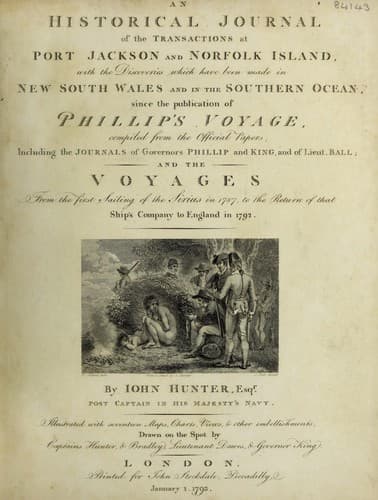
An Historical Journal of the Transactions at Port Jackson and Norfolk IslandHunter, John
History
An Historical Journal of the Transactions at Port Jackson and Norfolk Island
Hunter, John
New South Wales -- History -- Sources
We now observed that what we had taken for one island, was
three distinct islands; the westmost is very high, and is that
which Captain Carteret saw from his anchorage on the south coast
of Mindanao, and called Hummock Island; it appeared to be six
miles long from north to south; the next, to the eastward of it,
is about the same length, moderately high and level, and the
eastmost of the three, is a little round spot, covered with small
trees or shrubs; from the east side of this small island there is
a reef stretches to the eastward a considerable distance, and on
which the sea generally breaks: the other islands appear to be
quite encircled by a reef, at the distance of a cable and a half
from the shore. We passed between the small island and the next,
having previously sent a boat to try the channel; we found it a
clear safe passage, of one mile and a half wide; we kept about
one-third of the distance from the largest island, and had from
ten to twenty-five fathoms: in the shoalest water the ground was
hard, but in sixteen and eighteen fathoms it was soft: here the
tide or current set strong through to the westward; I rather
think it a regular tide, for we did not drift at the same rate
all day.
We continued to work between the south point of Mindanao and
these islands, during the remainder of the day; in the afternoon,
a boat was seen coming off from the high island, with twelve
persons on board, and a white flag flying; we stood towards them,
and answered their signal with a white flag at the ensign staff;
they came within a little distance of the ship, and asked a
variety of questions, whether we came from _Ternate_, (a
small island among the Moluccas, on which the Dutch have a
factory) and if we were going to Batavia; to which they were
answered in the affirmative; the conversation was carried on in
the Malay language, of which the master of the ship had some
knowledge, and as he had for a part of his crew twelve or
fourteen Javanese, who all spoke that language, and who also
spoke Dutch, we could be at no loss to be understood, or to
understand those with whom we conversed. Dutch colours were
hoisted to confirm the answer given: from this boat we learnt,
that they were upon intimate and friendly terms with the Dutch,
and that we might have as much water, wood, and various articles
of refreshment as we wanted. They desired to have a note from the
master of the ship to the Raja, by whom these islands were
governed, which was given them, with such information as might be
necessary.
Public-domain text, read in full here on John Shaqi.
Reviews
Reviews
No reviews yet
Be the first to share your thoughts on this work.
Elsewhere in the archive
Join the Discussion
Join the discussion
Sign in to leave a comment or review.
Sign InorCreate an account