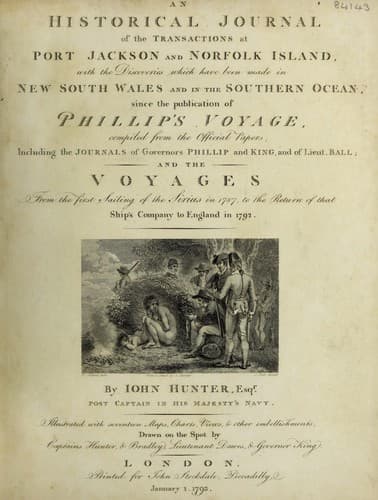
An Historical Journal of the Transactions at Port Jackson and Norfolk IslandHunter, John
History
An Historical Journal of the Transactions at Port Jackson and Norfolk Island
Hunter, John
New South Wales -- History -- Sources
We now had two formidable enemies to encounter in the rat and
grub-worm, both which were very numerous and destructive: some
wheat had been sown in the garden ground on the 11th, and the
next morning there was not a grain of it left, being all eat up
by the rats; and the few potatoes and other vegetables, which
escaped the bad effects of the southerly wind, were all eat up by
the grub-worm. I have before observed, that on our first
discovering the rats to be numerous, I ordered the empty casks to
be converted into traps, and for some time they were very
successful, thirty or forty rats being caught for several nights
together: these were killed, and scattered about the garden, to
deter the rest from coming to the place; but they soon grew too
cunning to be caught in the traps, and too bold to be intimidated
by their dead companions. I next caused some glass to be pounded
very fine, and mixed with oatmeal, which being distributed about
the garden, killed vast numbers of them.
To prevent the bad effects of the grub-worm, I tried ashes,
lye of ashes, and urine, but to no purpose, so that the women
were kept constantly employed in picking them off the few plants
we had left.
Out of six ewes which I brought to the island, five died with
the scab, notwithstanding every possible care was taken of them;
and one of my sows was poisoned, by eating something noxious in
the woods. The remainder of my small stock was likely to do very
well: it consisted of two ewes, three sows, two boars, four hens,
one cock, three ducks, one drake, and one goat.
The sugar-cane, two Rio Janeiro banana trees, and two orange
trees, which I brought with me, were kept in tubs, until I should
find a sheltered situation to plant them in. The wind seemed now
to be set in from the southward, and the weather was very raw and
cold, so that I called this the beginning of winter. Another of
my sows was poisoned on the 24th, so that I found it necessary to
confine them in a hog-pen, which, in regard to feeding them, was
a great inconvenience, as they used to provide very well for
themselves in the woods; fortunately, however, a tree was found
which afforded them very good food: this tree grows to the height
of eighty feet, and the branches, which resemble those of the
palm-tree in their growth, fall off every year, leaving an
indentation in the trunk. The leaves of these branches, which are
twelve in number, are much like the heath-fern, from whence this
tree obtained the name of the fern-tree. The middle of the tree,
from the root to the apex, consists of a white substance
resembling a yam, and when boiled, it tastes like a bad turnip;
this the hogs fed on very eagerly: the outside of the trunk is
hard wood, and full of regular indentations from the top to the
bottom. The tree is found in great plenty in all parts of the
island.
Public-domain text, read in full here on John Shaqi.
Reviews
Reviews
No reviews yet
Be the first to share your thoughts on this work.
Elsewhere in the archive
Join the Discussion
Join the discussion
Sign in to leave a comment or review.
Sign InorCreate an account