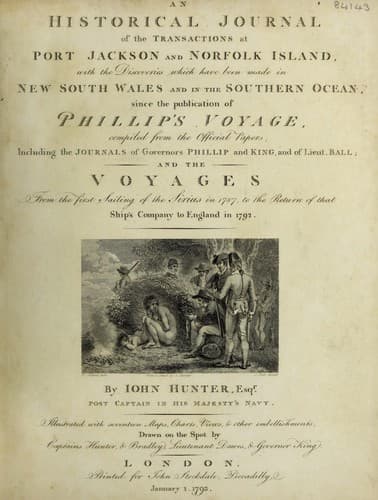
An Historical Journal of the Transactions at Port Jackson and Norfolk IslandHunter, John
History
An Historical Journal of the Transactions at Port Jackson and Norfolk Island
Hunter, John
New South Wales -- History -- Sources
On the 23d, we had very strong gales of wind at west by north,
but the landing was good early in the morning, and the large
coble was sent on board the Supply, (which was in the road) with
some of my baggage, and the officers and men belonging to the
Sirius, who were going to Port Jackson. The master of the Sirius,
with eight men, went on board the wreck by the hawser, and a
triangle was erected on the reef, to keep the bight of the hawser
from the ground; which would greatly facilitate the landing any
article from the wreck. The master informed Captain Hunter, by a
note, that Brannagin and Dring (the two convicts) had set fire to
the wreck, which had burnt through the gun deck; but had been
happily extinguished by Arscot, who went on board to send them
out of the ship: on this, they were ordered into confinement
previous to their being tried for setting fire to the wreck.
The weather being moderate and pleasant in the morning of the
24th, I went on board the Supply, along with Lieutenants
Waterhouse and Fowell, and twenty-two of the crew, belonging to
the late Sirius; and at noon, we made sail for Port Jackson.
As I have now taken leave of this island, I shall add my
general observations on it; and although several of them may
probably have been made before, in the course of this journal,
yet it perhaps may not be amiss to collect them together in one
point of view.
NORFOLK ISLAND.
By the mean of several meridional altitudes of the sun, and a
great number of lunar observations, the latitude of Sydney-Bay is
29 deg. 04' 40" south, and its longitude 168 deg. 12' east, of
Greenwich. The form of the island is a long square, and it
contains about fourteen thousand acres: it is six miles in length
and four in breadth.
Face of the country_.--The island is very hilly, and
some of the valleys are tolerably large, considering the size of
the island; but most of them are only deep hollows, formed by the
steep hills on each side, some of which rise so perpendicular
that they cannot be cultivated. There are some extensive plains
on the summits of the hills. Mount Pitt is the only remarkable
hill on the island, and is about two hundred fathoms high. The
cliffs round the island are about forty fathoms high, and are
quite perpendicular: the basis of them, as well as most of the
rocks and reefs round the island, is a hard, firm clay, of a very
fine texture. The whole island is covered with a very thick
forest, choaked up with underwood, which makes it impassable
until it is cleared away.
Public-domain text, read in full here on John Shaqi.
Reviews
Reviews
No reviews yet
Be the first to share your thoughts on this work.
Elsewhere in the archive
Join the Discussion
Join the discussion
Sign in to leave a comment or review.
Sign InorCreate an account