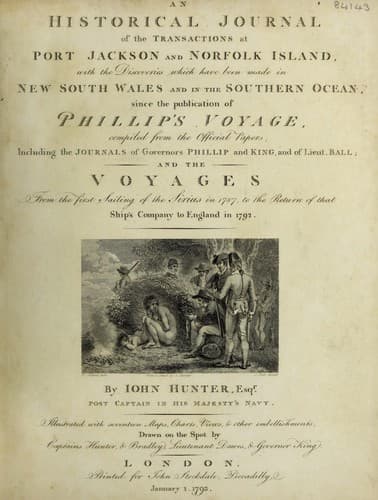
An Historical Journal of the Transactions at Port Jackson and Norfolk IslandHunter, John
History
An Historical Journal of the Transactions at Port Jackson and Norfolk Island
Hunter, John
New South Wales -- History -- Sources
-Water_.--The island is well supplied with many streams
of very fine water, some of which are sufficiently large to turn
a number of mills: it is probable that most of these rivulets
originate from springs near Mount Pitt. On a hill, near the
middle of the island, between Cascade and Sydney bays, there is a
pond of fresh water, about half an acre: there is no rivulet near
it, nor can any spring be perceived, yet, in the greatest
drought, it constantly remains full, and has a very good taste.
All these streams abound with very fine eels.
-Soil_.--From the sides of the cliffs which surround the
coast, to the summit of Mount Pitt, there is a continuation of
the finest soil, varying from a rich brown mould to a light red
earth. Some large stones are found on different parts of the
island.
-Air_.--As a proof of the salubrity and wholesomeness of
the air, it is to be remarked, that there had been scarcely any
sickness since I landed, nor had we any illness whatever, except
a few colds.
-Timber and trees_.--There are only five sorts of trees
on the island which can be called timber; viz. the pine, a wood
resembling the live oak; a yellow wood; a hard black wood; and a
wood resembling the English beech. The pine-trees are of a great
size, many of them being from one hundred and eighty to two
hundred and twenty feet high, and from four to eight feet
diameter some distance from the ground. Those trees, which
measure from one hundred to one hundred and eighty feet high, are
in general sound, and are without branches for eighty or ninety
feet, but the upper part is too knotty and hard to be useful;
indeed, it frequently happens, that after twenty feet have been
cut off from the butt, the trees becomes rotten and shaky, and is
also very brittle; for which reason, no dependance can be put on
them for masts or yards. The turpentine which exudes freely from
the bark, is of a milk-white glutinous substance; but it is
rather remarkable, that there is none in the timber. We tried to
render this turpentine useful in paying boats, and other
purposes, but without success; as it would neither melt nor burn:
we also tried to make pitch or tar, by burning the old pines; but
there being no turpentine in the wood, our efforts were useless.
The pine is very useful in buildings, and being dispersed in
various parts of the island, is well calculated for such
buildings as hereafter may be necessary: from what I have been
able to observe, it is very durable, as that which we had used
for erecting houses, stood the weather very well. Two cobles were
built of this wood, one of which was built in June, 1788: she was
water-soaked, owing to our want of any kind of stuff to pay her
with.
The live-oak, yellow-wood, black-wood, and beech, are all of a
close grain, and durable; in general they are from fourteen to
twenty inches diameter. The branches of the live-oak are fit for
timbers and knees of boats or small vessels.
Public-domain text, read in full here on John Shaqi.
Reviews
Reviews
No reviews yet
Be the first to share your thoughts on this work.
Elsewhere in the archive
Join the Discussion
Join the discussion
Sign in to leave a comment or review.
Sign InorCreate an account