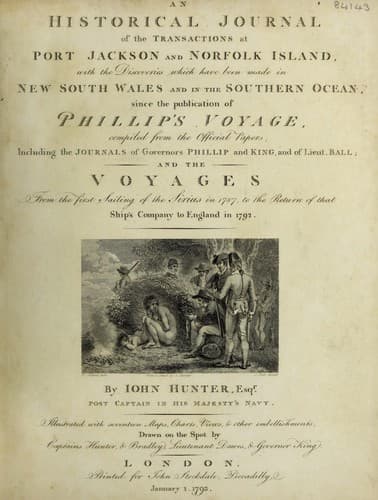
An Historical Journal of the Transactions at Port Jackson and Norfolk IslandHunter, John
History
An Historical Journal of the Transactions at Port Jackson and Norfolk Island
Hunter, John
New South Wales -- History -- Sources
Exclusive of this general approbation of the good conduct of
the free people, I must particularise Mr. Cresswell, the officer
of marines; Mr. Stephen Dunavan, midshipman; and Mr. Thomas
Jamieson, surgeon's mate, of the Sirius, I feel the greatest
satisfaction in saying that a constant, uniform propriety of
conduct, and a readiness in forwarding the service, were ever
zealously shown by these gentlemen.
At noon on the 24th, the Supply made sail, and we arrived at
Port Jackson on the 4th of April.
When I left Port Jackson in February, 1788, the ground about
Sydney-Cove was covered with a thick forest, but on my arrival at
this time, I found it cleared to a considerable distance, and
some good buildings were erected. The governor, the
lieutenant-governor, the judge-advocate, and the greatest part of
the civil and military officers were comfortably lodged. The
governor's house is built of stone, and has a very good
appearance, being seventy feet in front. The
lieutenant-governor's house is built of brick, as are also those
belonging to the judge and the commissary: the rest of the houses
are built with logs and plaistered; and all the roofs are either
covered with shingles or thatched. The hospital is a good
temporary building: the soldiers were in barracks, and the
officers had comfortable huts, with gardens adjoining to them;
but unfortunately, these gardens afford but little, as there is
not more than two feet of soil over a bed of rocks, and this soil
is little better than black sand; and to this inconvenience must
be added, the depredations of rats and thieves.
At the distance of an hour's walk from Sydney-Cove, the soil
is better in some places, and these are occupied by the officers
and others, as their farms: there are also brick-kilns and a
pottery, both which articles they make very well, but a great
inconvenience arises in their not being able to glaze the
earthenware.
From the little I saw of the soil about Sydney-Cove, I think
it is very bad, most of the ground being covered with rocks, or
large stones, which are used for building, and when cut, greatly
resemble the Portland stone; they are easily worked, and harden
very much after being wrought. A little below Sydney-Cove, there
is another, called Farm-Cove, at the head of which there are
about fifteen acres of ground in cultivation, but the soil is
very indifferent.
Governor Phillip, it seems, had made several excursions, in
order to inform himself more fully about the nature of the soil,
and to find out a place more proper for cultivation, than the
land about the lower part of the harbour; and, at length, had
fixed on a situation at the head of it, about eleven miles from
Sydney-Cove. The soil here was found to be much better than at
Sydney-Cove, and a number of convicts were sent there in 1789,
with a captain's guard, in order to prevent any disputes with the
natives, and to preserve regularity amongst the convicts.
Public-domain text, read in full here on John Shaqi.
Reviews
Reviews
No reviews yet
Be the first to share your thoughts on this work.
Elsewhere in the archive
Join the Discussion
Join the discussion
Sign in to leave a comment or review.
Sign InorCreate an account